

Amazon PPC search term mining is one of the most important processes for turning advertising data into a continuously improving keyword strategy.
Your campaigns generate far more customer search behavior than the keywords you originally entered. Broad match, phrase match, automatic targeting, product targeting, and other discovery mechanisms can expose your products to search queries you may never have considered during initial keyword research.
The Search Term Report gives you a way to investigate that behavior.
But advanced PPC optimization is not simply about finding a search term that generated one sale and adding it as an exact keyword.
A strong search-term mining process asks a much deeper set of questions:
- Is the search query genuinely relevant to the product?
- Is the query generating meaningful demand?
- Has the query demonstrated enough traffic to evaluate?
- Is the conversion performance statistically useful for the account?
- Is the query profitable at its current cost?
- Is the search term already being captured by another campaign?
- Should it be promoted into a dedicated exact-match target?
- Should the original discovery target receive a negative to reduce overlap?
- Is the keyword generating incremental sales or simply shifting existing sales between campaigns?
This article explains how to build a structured Amazon PPC search term mining system that moves from customer search behavior to validated keywords, controlled campaign targeting, and measurable incremental growth.
What Is Amazon PPC Search Term Mining?
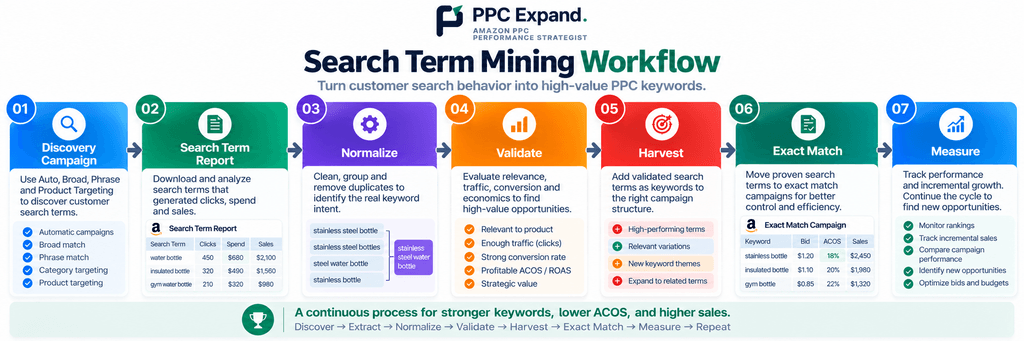
Amazon PPC search term mining is the process of analyzing customer search terms generated by advertising campaigns, identifying valuable queries, validating their performance, and converting qualified queries into deliberate keyword or product targets.
The basic concept is simple:
Discovery Campaigns → Search Terms → Validation → Keyword Harvesting → Dedicated Targeting → Optimization
However, the quality of the process depends on how carefully each stage is handled.
A search term should not automatically become a keyword simply because it generated a conversion.
Instead, the search term should pass through a qualification process that considers relevance, traffic, conversion, economics, campaign coverage, and strategic value.
Why Search Term Mining Matters in Amazon PPC
Keyword research performed before launching a campaign is based on what you believe customers may search for.
Search-term mining adds another layer: what customers actually searched when your advertising was eligible to appear.
That distinction is important.
A keyword tool may tell you that a phrase is popular. Your PPC data can tell you whether shoppers searching for that phrase are interacting with your particular product and whether the resulting traffic is commercially useful.
Amazon specifically recommends using Search Term Report data to identify high-performing customer searches that can be added as new targeting, while underperforming searches can be considered for negative targeting.
This creates a feedback loop:
- Launch discovery-oriented targeting.
- Collect customer search behavior.
- Identify meaningful search terms.
- Validate performance.
- Promote qualified terms.
- Control the original discovery traffic.
- Measure the result.
- Repeat the process.
Over time, the account becomes less dependent on assumptions and more informed by its own advertising data.
Search Term vs. Keyword: The Most Important Distinction

One of the most common PPC mistakes is treating a customer search term and a keyword as the same thing.
They are not.
| Customer Search Term | Keyword Target |
|---|---|
| The query entered by the shopper or identified by Amazon as the relevant search context. | The targeting expression you deliberately add to a campaign or ad group. |
| Represents observed shopper behavior. | Represents your advertising strategy. |
| Can be discovered through automatic or broader targeting. | Is intentionally selected by the advertiser. |
| May reveal unexpected keyword opportunities. | Provides greater control over bidding and targeting. |
For example, you may target:
water bottle
But the customer search term might be:
32 oz stainless steel water bottle for gym
If that query performs well, the search-term data has revealed a much more specific expression of customer intent.
That is the essence of keyword harvesting.
How the Search Term Mining System Works
A mature search-term mining system can be represented as:
- Discover: Generate search-term data through PPC targeting.
- Extract: Collect customer search terms from the available reporting data.
- Normalize: Clean and group similar queries.
- Qualify: Evaluate relevance, traffic, conversion, and economics.
- Prioritize: Rank opportunities according to account objectives.
- Harvest: Promote qualified terms into deliberate targeting.
- Isolate: Use campaign structure and negatives where appropriate.
- Optimize: Adjust bids, budgets, and targeting.
- Measure: Determine whether the change created incremental value.
This is much more powerful than simply downloading a report and sorting the Sales column from highest to lowest.
Step 1: Build the Right Search-Term Dataset
Before analyzing performance, establish the correct dataset.
For a meaningful analysis, consider combining search-term information across the relevant discovery campaigns rather than evaluating one campaign in isolation.
Depending on the account structure, this may include:
- Automatic Sponsored Products campaigns
- Broad-match discovery campaigns
- Phrase-match campaigns
- Category targeting
- Product targeting
- Other discovery-oriented campaign structures
Amazon’s current Sponsored Products Search Term Report includes search terms that resulted in at least one ad click. This means the report should not be interpreted as a complete record of every query for which the product received an impression.
This distinction matters when analyzing visibility or search coverage.
The Search Term Report is a performance dataset, not a complete search-demand database.
Step 2: Normalize Search Terms Before Making Decisions
Raw search-term data can contain thousands of variations.
Before making strategic decisions, group queries that represent the same underlying intent.
For example:
| Raw Search Terms | Potential Intent Group |
|---|---|
| stainless steel water bottle | Stainless steel water bottle |
| stainless steel water bottles | |
| steel water bottle stainless | |
| 32 oz stainless steel water bottle | 32 oz stainless steel water bottle |
| stainless steel bottle for gym | Gym stainless steel bottle |
This does not mean every variation should be merged operationally.
The purpose is to understand the underlying search intent before deciding whether a query deserves independent targeting.
Step 3: Start With Relevance, Not Sales
This is one of the biggest differences between basic and advanced search-term analysis.
Do not start by asking:
“Which search terms generated sales?”
Start by asking:
“Which search terms represent customers I actually want?”
A search term can generate a sale and still be strategically problematic.
For example, imagine a premium stainless-steel bottle is generating sales from:
- cheap plastic water bottle
- kids plastic bottle
- disposable water bottle
Even if one of these terms produces a sale, it may not represent a scalable or strategically desirable customer segment.
Revenue alone does not determine relevance.
Step 4: Segment Search Terms by Intent
Search terms can become easier to analyze when they are grouped by customer intent.
| Intent Type | Example | Typical Interpretation |
|---|---|---|
| Core category | water bottle | Broad category demand |
| Feature-driven | leakproof water bottle | Specific product requirement |
| Material-driven | stainless steel water bottle | Material preference |
| Use-case | water bottle for gym | Specific customer use case |
| Audience-driven | water bottle for hiking | Specific user or activity |
| Size-driven | 32 oz water bottle | Specific product specification |
| Low relevance | plastic disposable bottle | Potentially mismatched intent |
Intent segmentation allows you to move beyond individual keywords and identify entire keyword themes that may deserve expansion.
Step 5: Evaluate Traffic Before Declaring a Winner
A single order does not necessarily make a search term a proven keyword.
Consider two hypothetical search terms:
| Search Term | Clicks | Orders | Conversion Rate |
|---|---|---|---|
| Keyword A | 3 | 1 | 33.3% |
| Keyword B | 150 | 18 | 12.0% |
Keyword A has the higher observed conversion rate, but the sample is extremely small.
Keyword B has generated considerably more traffic and orders, giving you a larger evidence base.
This is why advanced PPC analysis should avoid blindly sorting by conversion rate.
Always interpret conversion metrics alongside traffic volume.
Step 6: Evaluate Spend, Sales, ACOS, and ROAS Together
After relevance and traffic, move into economic evaluation.
At minimum, evaluate:
- Spend
- Sales
- Orders
- Clicks
- ACOS
- ROAS
- Conversion rate
- CPC
For example:
| Search Term | Clicks | Spend | Sales | Orders | ACOS | Interpretation |
|---|---|---|---|---|---|---|
| stainless steel water bottle | 210 | $320 | $1,450 | 24 | 22.1% | Potential harvest |
| insulated water bottle | 450 | $680 | $2,100 | 28 | 32.4% | Review efficiency |
| gym water bottle | 180 | $260 | $980 | 14 | 26.5% | Potential test |
| cheap plastic bottle | 95 | $140 | $0 | 0 | — | Review relevance / negative |
All figures in this table are illustrative examples, not Amazon benchmarks.
The correct decision depends on the account’s target ACOS, margin structure, lifecycle stage, and business objectives.
Step 7: Establish a Keyword Harvesting Qualification Rule

There is no universal click count, order count, or ACOS threshold that makes a search term automatically qualified.
Instead, create account-specific qualification rules.
A practical framework can evaluate five dimensions:
| Dimension | Question |
|---|---|
| Relevance | Does the query represent the product accurately? |
| Traffic | Has the query received enough clicks to evaluate? |
| Conversion | Has it demonstrated meaningful purchase behavior? |
| Economics | Does its advertising cost make sense? |
| Strategic value | Does the query represent a valuable customer segment or keyword theme? |
A search term that passes all five dimensions is a much stronger harvesting candidate than a term selected from one metric alone.
Step 8: Separate Discovery From Scaling
This is one of the most important principles in advanced PPC campaign architecture.
Discovery and scaling are different jobs.
Discovery campaigns are designed to find opportunities.
Scaling campaigns are designed to give proven opportunities more controlled exposure.
| Discovery | Scaling |
|---|---|
| Automatic targeting | Dedicated keyword targeting |
| Broad match | Exact match |
| Wider exploration | Controlled targeting |
| Search-term discovery | Performance optimization |
| Higher uncertainty | Higher evidence |
Amazon itself describes search-term data as a way to identify high-performing searches that can then be added as targeting. Amazon also provides Target Promotion functionality designed to help advertisers harvest high-performing targets and refine their targeting.
Step 9: Harvest the Keyword Into the Right Campaign
Once a search term qualifies, the next question is not simply:
“Should I add this keyword?”
The better question is:
“Where should this keyword live?”
For example, a proven search term might be promoted into:
- A dedicated exact-match campaign
- An existing exact-match campaign for the same keyword theme
- A phrase-match campaign for controlled expansion
- A structured campaign built around a specific product or keyword cluster
The correct architecture depends on how the account is already structured.
Step 10: Use Match Types as a Discovery-to-Control System
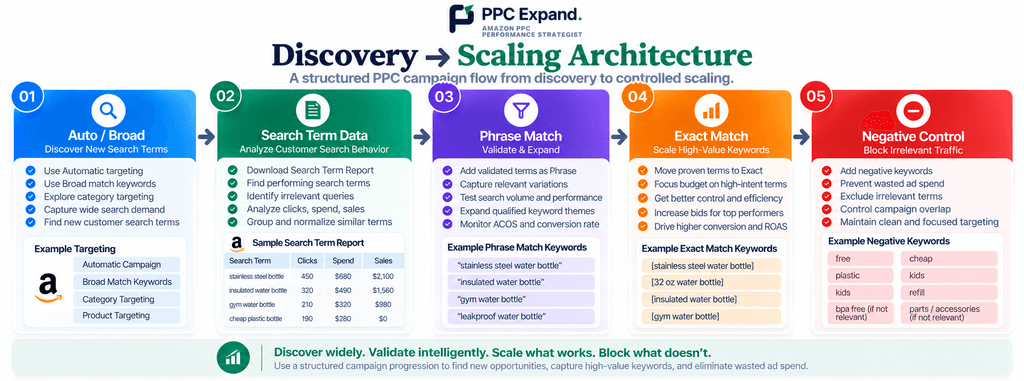
Amazon Sponsored Products supports broad, phrase, and exact keyword match types. Amazon describes these match types as different levels of targeting control, with broad providing greater reach and exact providing more restrictive targeting.
A practical harvesting architecture can look like this:
- Broad / Auto: Discover search behavior.
- Search Term Report: Identify promising customer queries.
- Phrase: Test and expand around validated themes.
- Exact: Isolate proven high-value queries.
- Negative Targeting: Control unwanted overlap and waste.
This creates a controlled progression from uncertainty to greater targeting precision.
Step 11: Decide Whether to Add a Negative
Keyword harvesting and negative targeting should be considered together.
Suppose an automatic campaign discovers:
stainless steel water bottle
and you promote that query into a dedicated exact-match campaign.
You now have two potential sources of traffic:
- The discovery campaign
- The dedicated exact campaign
Depending on your campaign architecture and objectives, negative targeting can be used to control where certain traffic is captured.
Amazon supports negative keyword targeting in Sponsored Products and explains that negative targets can prevent ads from appearing against shopping results that do not meet campaign objectives.
However, negative targeting should not be applied mechanically.
Before adding a negative, understand:
- Where the search term currently converts
- Which campaign owns the traffic
- Whether another campaign is intended to capture it
- Whether the negative could remove useful discovery traffic
- Whether the goal is efficiency, isolation, or budget control
Negatives are a routing mechanism, not simply a waste-removal button.
Step 12: Look for Cannibalization
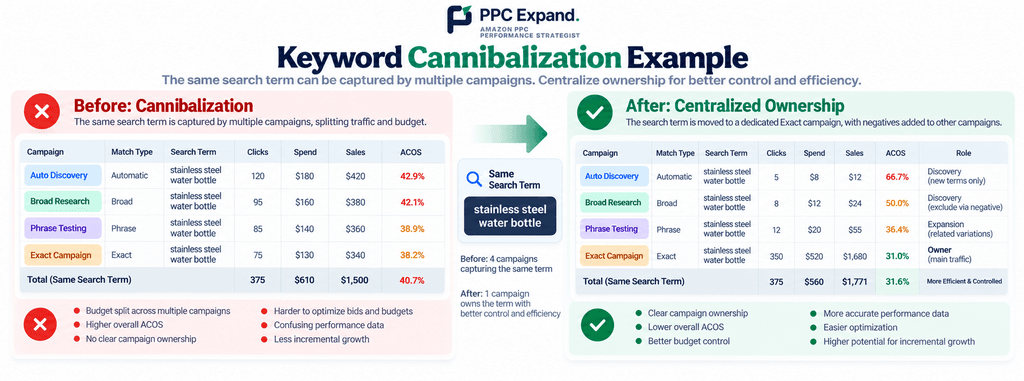
One of the more advanced problems in large PPC accounts is keyword cannibalization.
A search query may be eligible across multiple campaigns that target similar products or keywords.
For example:
| Campaign | Targeting | Search Term | Spend | Sales |
|---|---|---|---|---|
| Auto Discovery | Automatic | stainless steel water bottle | $120 | $520 |
| Broad Discovery | water bottle | stainless steel water bottle | $85 | $360 |
| Exact Scale | stainless steel water bottle | stainless steel water bottle | $140 | $720 |
The total sales may look excellent.
But the strategic question is:
Which campaign should own this search term?
Without campaign-level analysis, simply adding the keyword to more campaigns can increase complexity without creating incremental growth.
Search-Term Harvesting Is Not the Same as Keyword Duplication
A common mistake is repeatedly adding the same keyword to multiple campaigns without a clear reason.
More targeting does not automatically mean more sales.
A mature account should have an intentional reason for each keyword’s placement.
For example:
| Keyword Role | Purpose |
|---|---|
| Discovery | Find new customer search behavior |
| Validation | Test whether the search term deserves greater investment |
| Exact scaling | Give proven demand greater targeting control |
| Defensive | Protect important brand or product-related searches |
| Negative | Control irrelevant or strategically unwanted traffic |
Every placement should have a purpose.
Step 13: Analyze Keyword Themes, Not Just Individual Terms
Advanced search-term mining goes beyond individual keywords.
Suppose your Search Term Report reveals:
- stainless steel water bottle
- stainless steel bottle for gym
- stainless steel sports bottle
- insulated stainless steel bottle
- stainless steel reusable bottle
Instead of treating these as five unrelated discoveries, identify the underlying theme:
Stainless Steel Product Intent
This theme can then be investigated across:
- SQP
- Search Term Report
- Keyword research tools
- Competitor listings
- Organic ranking data
- PPC campaign structure
This is how search-term mining becomes a broader keyword expansion engine.
Step 14: Connect Search Term Mining With SQP
This is where the previous PPC Expand articles connect directly with this one.
SQP can reveal the broader search opportunity, while PPC search-term data can show how your advertising is interacting with customer searches.
Consider the workflow:
- SQP: Identify a relevant high-demand query.
- PPC Search Term Report: Determine whether your campaigns are already capturing it.
- Performance Analysis: Evaluate clicks, spend, sales, and conversion.
- Keyword Qualification: Determine whether the query deserves promotion.
- Campaign Action: Add or restructure targeting.
- Measurement: Evaluate the incremental result.
This creates a stronger connection between search intelligence and PPC execution.
Step 15: Build a Search-Term Opportunity Score
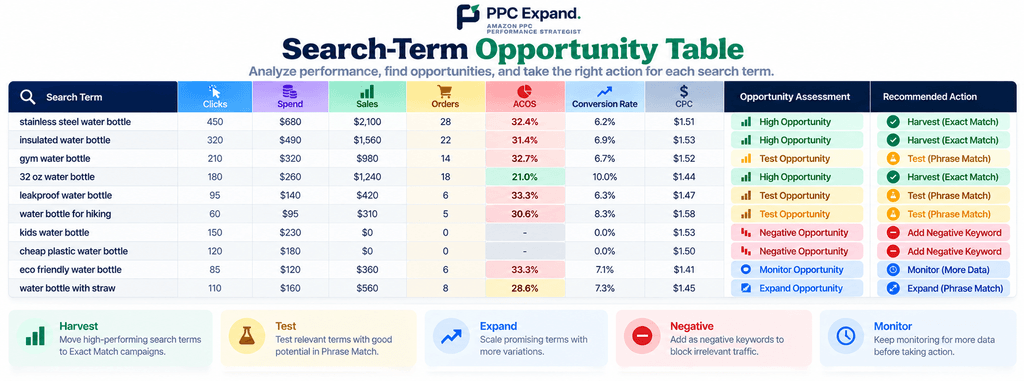
For larger accounts, a scoring framework can help prioritize hundreds or thousands of search terms.
An internal opportunity score might consider:
- Relevance
- Search demand
- Clicks
- Orders
- Conversion rate
- ACOS
- ROAS
- Visibility opportunity
- Competition
- Strategic importance
For example:
| Factor | Low Signal | Medium Signal | High Signal |
|---|---|---|---|
| Relevance | Weak | Related | Exact product intent |
| Demand | Limited | Moderate | Strong |
| Traffic | Low | Moderate | Strong evidence |
| Conversion | Weak | Average | Strong |
| Economics | Unprofitable | Acceptable | Strong |
| Strategic Value | Low | Useful | High priority |
This is a PPC Expand analytical framework, not an Amazon metric.
Do Not Use a Universal “X Clicks = Harvest” Rule
Many PPC workflows rely on simplistic rules such as:
“After 10 clicks, harvest.”
or:
“After one sale, move the keyword to exact.”
These rules can be useful as operational shortcuts, but they are not universally reliable.
The appropriate evidence threshold depends on:
- Average order value
- Conversion rate
- Click cost
- Margin
- Target ACOS
- Category competition
- Product maturity
- Sales velocity
- Available traffic
- Business growth objectives
A $15 product and a $300 product should not necessarily have the same keyword qualification threshold.
Use rules to accelerate analysis, not to replace analysis.
When a Search Term Should Not Be Harvested
Not every converting search term deserves its own keyword.
You may choose not to harvest a term when:
- The search query is only loosely related to the product.
- The conversion came from an extremely small sample.
- The keyword has poor economics.
- The query is seasonal and the opportunity is temporary.
- The search term is already adequately controlled elsewhere.
- The keyword creates unnecessary campaign duplication.
- The query does not align with the product’s intended positioning.
- The apparent performance is driven by branded or navigational demand you do not need to expand.
Good PPC optimization is not about maximizing the number of keywords in the account.
It is about maximizing the number of useful, controllable, economically justified targets.
Branded vs. Non-Branded Search-Term Mining
Search terms should also be classified by brand intent.
| Type | Example | Analysis Consideration |
|---|---|---|
| Branded | Your Brand Water Bottle | Often reflects existing brand demand |
| Non-branded | Stainless Steel Water Bottle | Potential category acquisition opportunity |
| Competitor | Competitor Brand Water Bottle | Evaluate relevance and strategy separately |
Mixing these groups can distort your analysis.
A branded search may produce excellent ACOS because the shopper already intended to buy from your brand. That does not necessarily mean the same economics can be achieved with a generic category keyword.
Always understand the intent behind the conversion.
How to Handle ASINs in Search-Term Data
Search-term reporting can also surface alphanumeric entries corresponding to ASINs in certain Sponsored Products targeting contexts.
Amazon notes that these can appear for automatic-targeted campaigns and product-attribute-targeted ad groups, representing product-detail-page contexts where ads were displayed. These ASINs can be evaluated for negative targeting or manual product targeting.
That creates another mining opportunity:
- Identify ASINs generating profitable sales.
- Analyze the product relationship.
- Determine whether the ASIN represents a competitor or complementary product.
- Evaluate whether it should become a deliberate product target.
- Exclude irrelevant or inefficient ASIN traffic where appropriate.
Search-term mining therefore does not have to be limited to keyword targeting.
Step 16: Measure Incremental Performance After Harvesting
This is where many keyword-harvesting systems stop too early.
They identify a keyword, add it to a campaign, and declare success.
An advanced analyst asks:
Did the harvested keyword create incremental value?
Track the performance before and after the change.
| Metric | Before Harvest | After Harvest | What to Evaluate |
|---|---|---|---|
| Impressions | Baseline | New level | Did visibility increase? |
| Clicks | Baseline | New level | Did qualified traffic increase? |
| Spend | Baseline | New level | What did the additional traffic cost? |
| Orders | Baseline | New level | Did sales increase? |
| ACOS | Baseline | New level | Did efficiency remain acceptable? |
| Total Sales | Baseline | New level | Was growth incremental? |
Do not judge a keyword only by the performance of the new campaign.
Evaluate the account-level effect where possible.
The Difference Between Campaign Growth and Account Growth
Suppose an exact-match campaign generates an additional $1,000 in attributed sales after harvesting a keyword.
That sounds positive.
But if another campaign loses $900 in sales because the same traffic moved from one campaign to another, the account-level incremental impact is much smaller than the campaign-level report suggests.
This is why advanced PPC analysis should distinguish between:
- Campaign performance
- Keyword performance
- Search-term performance
- Account-level performance
- Incremental performance
Optimization should ultimately be judged by the business outcome, not just by which campaign has the highest reported ROAS.
A Practical Search-Term Mining Workflow
Here is a repeatable workflow that can be used during account optimization:
- Export or review Search Term Report data.
- Combine relevant discovery campaigns.
- Normalize search-term variations.
- Remove clearly irrelevant queries.
- Classify search intent.
- Review clicks, spend, sales, orders, ACOS, ROAS, and conversion.
- Identify high-value search terms.
- Compare against existing keyword coverage.
- Check for campaign overlap and cannibalization.
- Decide whether to harvest, monitor, optimize, or exclude.
- Move qualified queries into the appropriate campaign structure.
- Apply negative targeting where strategically appropriate.
- Adjust bids and budgets according to the campaign role.
- Measure incremental account-level impact.
- Repeat the process.
The PPC Expand Search-Term Mining Framework
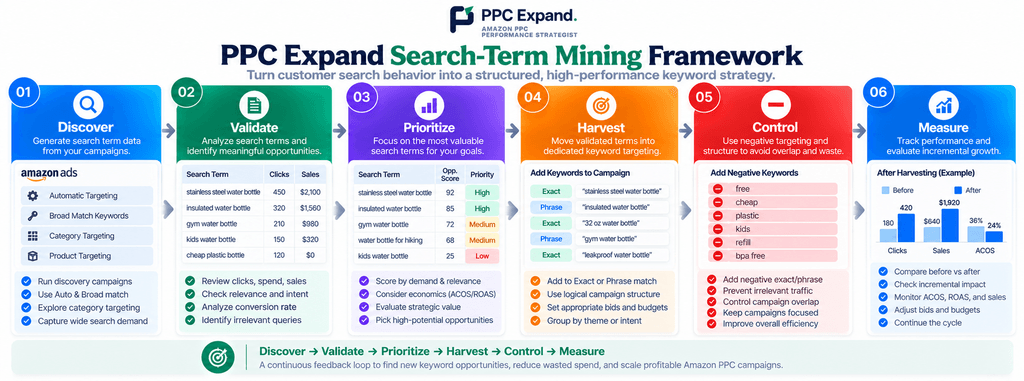
At PPC Expand, the search-term mining process can be simplified into six strategic stages:
| Stage | Question | Action |
|---|---|---|
| 1. Discover | What are customers searching for? | Collect search-term data. |
| 2. Validate | Is the query relevant and commercially useful? | Analyze intent and performance. |
| 3. Prioritize | Which queries deserve greater attention? | Rank by demand, performance, economics, and strategic value. |
| 4. Harvest | Should the query become a deliberate target? | Promote it into the appropriate campaign. |
| 5. Control | Where should the traffic come from? | Use campaign structure and negatives strategically. |
| 6. Measure | Did the change create incremental value? | Evaluate performance at campaign and account level. |
Common Amazon PPC Search-Term Mining Mistakes
1. Harvesting Every Search Term With a Sale
One conversion is not automatically sufficient evidence to create a new keyword.
2. Sorting Only by ACOS
ACOS should be evaluated alongside traffic, sales volume, conversion, strategic value, and business objectives.
3. Ignoring Relevance
A profitable but strategically irrelevant query can create misleading short-term performance.
4. Ignoring Search-Term Volume
Conversion rate from three clicks is not equivalent to conversion rate from hundreds of clicks.
5. Duplicating Keywords Across Too Many Campaigns
More targeting does not automatically create more incremental sales.
6. Using Negatives Without Understanding Traffic Ownership
A negative keyword can solve overlap in one campaign while unintentionally removing useful discovery elsewhere.
7. Measuring Only the New Campaign
A new exact campaign can look successful while simply taking sales away from another campaign.
8. Treating the Search Term Report as a Complete Search-Demand Dataset
Amazon’s Sponsored Products Search Term Report includes terms that generated at least one ad click, so it should not be treated as a complete representation of all search queries or impressions.
How Often Should You Mine Search Terms?
The right cadence depends on account size and sales velocity.
| Account Situation | Suggested Analysis Focus |
|---|---|
| High-volume account | Frequent search-term monitoring and structured harvesting |
| Medium-volume account | Weekly or biweekly performance review |
| Low-volume account | Allow enough data to accumulate before making aggressive decisions |
| Seasonal account | Compare current performance with relevant seasonal periods |
| New product | Focus heavily on discovery and learning before aggressive isolation |
Amazon currently documents a 65-day lookback for the Sponsored Products Search Term Report, so historical analysis should be planned around the available reporting window and the account’s own data-storage process.
Search-Term Mining Is a Continuous Feedback Loop
The strongest PPC accounts do not treat keyword research as something that happens only before campaign launch.
Instead, advertising itself becomes a source of keyword intelligence.
The cycle becomes:
Keyword Research → Campaign Launch → Customer Search Data → Search-Term Mining → Keyword Expansion → Campaign Refinement → New Search Data
Every cycle can improve the next one.
This is particularly powerful when combined with SQP analysis.
SQP can help identify broader search opportunities, while PPC search-term data helps reveal which customer queries your advertising is actually reaching and converting against.
Final Takeaway
Amazon PPC search term mining is not simply a process of finding keywords that generated sales.
It is a structured method for converting real customer search behavior into a more controlled PPC targeting system.
The strongest process is:
Discover → Normalize → Validate → Prioritize → Harvest → Control → Measure
When done correctly, search-term mining can help you:
- Discover keywords your original research missed.
- Identify high-value customer intent.
- Separate discovery from scaling.
- Build more deliberate exact-match campaigns.
- Reduce irrelevant traffic.
- Improve campaign structure.
- Control keyword overlap.
- Identify new keyword themes.
- Turn PPC data into SEO insights.
- Continuously improve your advertising strategy.
The real objective is not to build the largest keyword list.
The objective is to build a progressively smarter targeting system where every validated search query has a strategic role.
Frequently Asked Questions
What is Amazon PPC search term mining?
Amazon PPC search term mining is the process of analyzing customer search queries generated through advertising, identifying valuable opportunities, validating their performance, and turning qualified queries into deliberate PPC targets.
What is the difference between a keyword and a search term?
A keyword is a targeting expression selected by the advertiser. A search term is the customer’s actual search query or relevant search context reported by Amazon. Search-term mining uses observed customer behavior to improve keyword targeting.
When should I add a search term as an exact-match keyword?
There is no universal click or order threshold. Evaluate relevance, traffic volume, conversion, advertising economics, strategic value, and existing campaign coverage before promoting a search term.
Should every converting search term become a keyword?
No. A converting search term may have insufficient data, weak relevance, poor economics, limited strategic value, or may already be adequately controlled elsewhere.
Should I add negative keywords after harvesting?
Negative targeting can be useful for controlling unwanted traffic or campaign overlap, but it should be applied based on the intended campaign structure and traffic ownership rather than automatically after every keyword harvest.
Can search-term mining help Amazon SEO?
Yes. Search terms can reveal the language customers use to describe their needs, features, use cases, and product intent. Those insights can support broader Amazon SEO and listing optimization research.
How does SQP work with Search Term Report analysis?
SQP can help identify search opportunities and product-level search performance, while the PPC Search Term Report provides advertising search-term performance. Combining both datasets creates a stronger framework for identifying and validating keyword opportunities.