

Amazon PPC N-Gram analysis is one of the most powerful ways to move beyond individual search-term analysis and understand the patterns hiding inside your advertising data.
Table of content
- What Is Amazon PPC N-Gram Analysis?
- Why N-Gram Analysis Matters in Amazon PPC
- N-Gram vs. Search-Term Analysis
- How N-Grams Work
- When Should You Use 1-Gram, 2-Gram, or 3-Gram Analysis?
- The Core N-Gram Metrics
- Why Frequency Alone Can Be Misleading
- Building an N-Gram Performance Table
- How to Find Wasted Spend With N-Gram Analysis
- Do Not Automatically Negative Every Poor N-Gram
- Finding Hidden Keyword Opportunities With N-Grams
- N-Gram Analysis for Keyword Expansion
- N-Gram Analysis and Search Term Mining Work Together
- N-Gram Analysis for Negative Keyword Research
- N-Gram Analysis for Product-Market Fit Signals
- N-Gram Analysis for Amazon SEO
- N-Gram Analysis and SQP
- A Practical N-Gram Analysis Workflow
- Building an Advanced N-Gram Dashboard
- How to Prioritize N-Grams
- Do Not Judge N-Grams Without Context
- N-Gram Analysis for Large Amazon PPC Accounts
- N-Gram Analysis by Product or ASIN
- N-Gram Analysis by Campaign Type
- How N-Gram Analysis Can Improve Budget Allocation
- Advanced N-Gram Analysis: Separate Brand From Generic Demand
- Advanced N-Gram Analysis: Search Intent Clusters
- N-Gram Analysis Mistakes to Avoid
- A Practical PPC Expand N-Gram Analysis Framework
- How N-Gram Analysis Fits Into the PPC Expand System
- Final Takeaway
- Frequently Asked Questions
- What is an N-Gram in Amazon PPC?
- What is the difference between a 1-Gram and a 2-Gram?
- Can N-Gram analysis find negative keywords?
- Can N-Gram analysis find new keywords?
- What metrics should I use for N-Gram analysis?
- Should I analyze 1-Grams, 2-Grams, and 3-Grams?
- Can N-Gram analysis replace search-term analysis?
- Can N-Gram analysis be combined with Amazon SQP?
- Related PPC Expand Resources
A search-term report may contain hundreds, thousands, or even millions of customer queries over time. Reviewing those queries one by one can reveal individual opportunities, but it can also make it difficult to identify broader patterns.
That is where N-Gram analysis becomes valuable.
Instead of asking only:
“Which search terms are performing well?”
N-Gram analysis asks:
“Which words and recurring phrases are consistently associated with profitable or unprofitable search behavior?”
This can help uncover:
- Recurring wasted-spend patterns
- Profitable keyword themes
- Hidden customer intent
- Negative keyword opportunities
- New keyword expansion opportunities
- Product-feature demand
- Use-case opportunities
- Audience-specific search patterns
- Search-term patterns that individual keyword analysis can miss
In this guide, we’ll explain how advanced Amazon PPC analysts can use N-Gram analysis to turn large search-term datasets into actionable campaign decisions.
What Is Amazon PPC N-Gram Analysis?
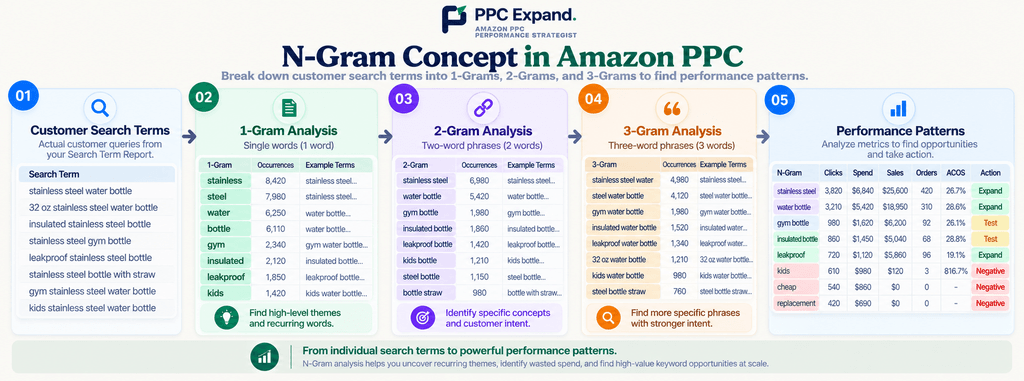
An N-Gram is a sequence of one or more words extracted from a larger text dataset.
In Amazon PPC analysis, N-Gram analysis breaks customer search terms into smaller components and aggregates performance across those components.
For example, consider these search terms:
- stainless steel water bottle
- 32 oz stainless steel water bottle
- insulated stainless steel bottle
- stainless steel gym bottle
- stainless steel bottle with straw
A traditional keyword analysis might treat each search term independently.
N-Gram analysis can identify recurring components such as:
| N-Gram | Type | Example Search Terms |
|---|---|---|
| stainless | 1-Gram | Multiple stainless-steel queries |
| steel | 1-Gram | Multiple steel-related queries |
| water bottle | 2-Gram | Multiple category searches |
| stainless steel | 2-Gram | Multiple material-intent searches |
| stainless steel water | 3-Gram | More specific product intent |
The goal is not simply to count how often a word appears.
The goal is to understand how performance changes when a recurring word or phrase appears across multiple customer searches.
Why N-Gram Analysis Matters in Amazon PPC
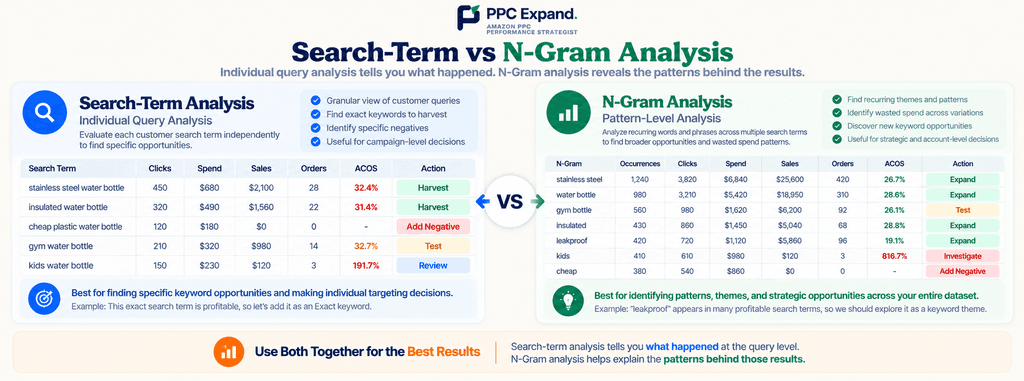
Search-term reports provide granular data.
N-Gram analysis provides pattern-level data.
That distinction becomes increasingly important as an account grows.
Imagine an account has 20,000 search-term rows.
Analyzing every search term individually may reveal hundreds of isolated winners and losers. But N-Gram analysis can reveal that many of those search terms share the same underlying word.
For example:
| Search Term | Spend | Sales |
|---|---|---|
| cheap plastic water bottle | $95 | $0 |
| cheap water bottle for gym | $72 | $0 |
| cheap reusable water bottle | $64 | $0 |
| cheap kids water bottle | $58 | $0 |
Individually, these are four poor search terms.
At the N-Gram level, however, the recurring word “cheap” becomes a potentially important signal.
This is the difference between:
Finding bad keywords
and:
Finding the pattern creating bad keywords.
N-Gram vs. Search-Term Analysis
| Search-Term Analysis | N-Gram Analysis |
|---|---|
| Evaluates individual customer queries | Evaluates recurring words and phrases |
| Excellent for keyword harvesting | Excellent for identifying patterns |
| Useful for individual targeting decisions | Useful for theme-level decisions |
| Shows specific query performance | Aggregates performance across related queries |
| Can identify individual negatives | Can identify broader negative themes |
| Usually more granular | Usually more pattern-oriented |
The two methods should be used together.
Search-term analysis tells you what happened at the query level. N-Gram analysis helps explain the patterns behind those results.
How N-Grams Work
The simplest way to understand N-Grams is by looking at the number of words included.
| N-Gram Type | Example | Typical Use |
|---|---|---|
| 1-Gram | stainless | Broad recurring themes |
| 2-Gram | stainless steel | Specific concepts |
| 3-Gram | stainless steel bottle | More specific intent |
| 4-Gram | stainless steel water bottle | Highly specific phrases |
Each level answers a slightly different question.
For example:
1-Gram: What recurring words appear throughout my search data?
2-Gram: Which word combinations represent meaningful themes?
3-Gram: Which more specific phrases consistently appear?
4-Gram: Which highly specific search concepts are recurring?
When Should You Use 1-Gram, 2-Gram, or 3-Gram Analysis?
1-Gram Analysis
Use 1-Gram analysis when you want to identify broad recurring themes.
Examples:
- cheap
- kids
- professional
- stainless
- glass
- replacement
1-Grams are especially useful for finding recurring negative themes.
2-Gram Analysis
2-Grams provide more context.
Examples:
- stainless steel
- water bottle
- gym bottle
- kids bottle
- replacement lid
They can be useful for identifying product attributes, use cases, and customer intent.
3-Gram Analysis
3-Grams provide even greater specificity.
Examples:
- stainless steel bottle
- water bottle gym
- water bottle straw
- 32 oz water bottle
These can be particularly useful when identifying keyword expansion opportunities.
The Core N-Gram Metrics
A useful N-Gram dashboard should not stop at frequency.
For PPC analysis, consider tracking:
- Occurrences
- Impressions
- Clicks
- Spend
- Orders
- Sales
- CTR
- Conversion rate
- CPC
- ACOS
- ROAS
- Cost per order
This allows you to distinguish between a word that appears frequently and a word that actually influences performance.
Why Frequency Alone Can Be Misleading
Suppose the word “water” appears in 8,000 search terms.
That sounds important.
But “water” may simply be a generic category word that appears throughout the entire dataset.
High frequency does not automatically mean high strategic value.
Now compare it with:
“leakproof”
It might appear in only 300 search terms, but those searches could produce a disproportionately strong conversion rate and ROAS.
Therefore:
Frequency tells you how often a pattern appears. Performance tells you whether that pattern matters.
Building an N-Gram Performance Table

A practical N-Gram report might look like this:
| N-Gram | Occurrences | Clicks | Spend | Sales | Orders | ACOS | Action |
|---|---|---|---|---|---|---|---|
| stainless | 1,240 | 3,200 | $4,800 | $21,500 | 310 | 22.3% | Expand |
| leakproof | 420 | 980 | $1,420 | $7,600 | 112 | 18.7% | Expand |
| cheap | 310 | 720 | $1,050 | $120 | 3 | 875.0% | Investigate Negative |
| kids | 275 | 610 | $820 | $240 | 6 | 341.7% | Review Relevance |
| gym | 560 | 1,340 | $1,950 | $9,200 | 136 | 21.2% | Expand |
The figures above are illustrative examples, not Amazon benchmarks.
The important point is that the analysis aggregates multiple search terms containing each N-Gram.
How to Find Wasted Spend With N-Gram Analysis
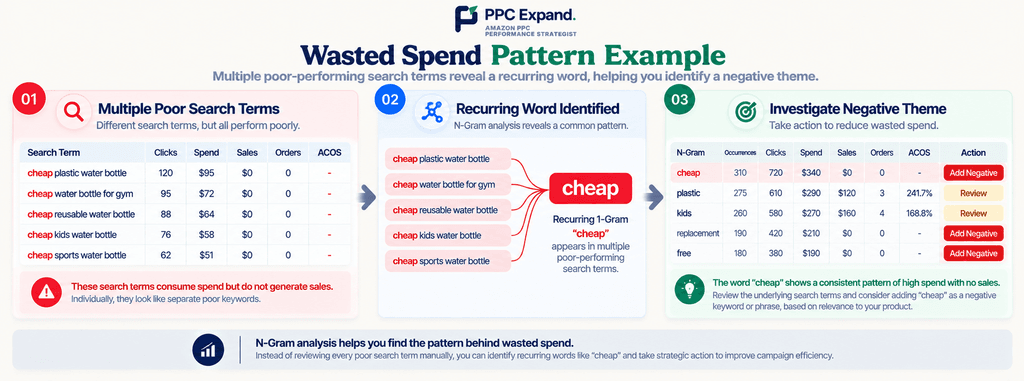
One of the strongest applications of N-Gram analysis is identifying recurring sources of wasted spend.
Start with search terms that have:
- Meaningful spend
- Few or no orders
- Weak conversion
- Poor ACOS or ROAS
Then break those search terms into N-Grams.
Look for words that repeatedly occur across the poor-performing searches.
For example:
| Search Term | Spend | Orders | Recurring Pattern |
|---|---|---|---|
| cheap plastic water bottle | $95 | 0 | cheap |
| cheap water bottle gym | $72 | 0 | cheap |
| cheap reusable bottle | $64 | 0 | cheap |
| cheap sports bottle | $51 | 0 | cheap |
Instead of manually reviewing every query, the N-Gram analysis surfaces “cheap” as a recurring pattern.
This can trigger a deeper relevance and negative-targeting investigation.
Do Not Automatically Negative Every Poor N-Gram
This is one of the most important safeguards in N-Gram analysis.
An N-Gram with poor aggregate performance is not automatically a negative keyword.
For example, suppose:
“gym” has a high ACOS overall.
That does not mean every search containing “gym” should be blocked.
You may have:
- gym water bottle — profitable
- gym stainless steel bottle — profitable
- gym bottle with straw — profitable
- cheap gym bottle — unprofitable
- kids gym bottle — irrelevant
The correct conclusion may be that specific combinations are problematic rather than the word “gym” itself.
N-Gram analysis identifies patterns to investigate. It does not replace search-term-level judgment.
Finding Hidden Keyword Opportunities With N-Grams
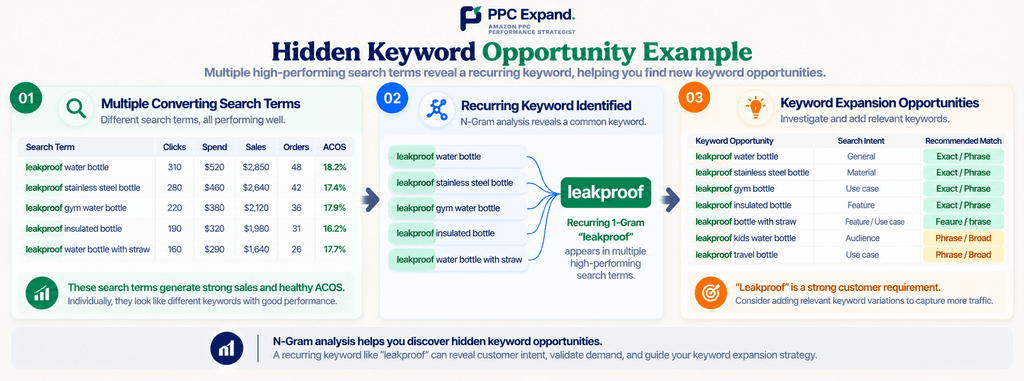
N-Gram analysis is equally useful for discovering profitable themes.
Suppose the search-term report contains:
- leakproof stainless steel water bottle
- leakproof gym water bottle
- leakproof water bottle for hiking
- leakproof insulated water bottle
Individually, these are different search queries.
At the N-Gram level, “leakproof” becomes a recurring product requirement.
If the aggregate performance is strong, that may justify investigating:
- leakproof as a keyword
- leakproof water bottle
- leakproof bottle for gym
- leakproof bottle for hiking
- leakproof insulated bottle
The N-Gram has therefore become a keyword expansion signal.
N-Gram Analysis for Keyword Expansion
A useful expansion workflow is:
- Identify high-performing N-Grams.
- Review the search terms containing those N-Grams.
- Understand the customer intent behind the pattern.
- Identify recurring variations.
- Check SQP and broader keyword research data.
- Determine whether the theme deserves dedicated targeting.
- Build appropriate exact, phrase, or broad targets.
- Measure the resulting performance.
This turns N-Gram analysis into a keyword discovery engine rather than merely a reporting exercise.
N-Gram Analysis and Search Term Mining Work Together
Article #4 focused on search-term mining.
N-Gram analysis extends that process.
The relationship looks like this:
Search Terms → Individual Opportunities → N-Grams → Recurring Themes → Strategic Actions
Search-term mining tells you:
“This query performed well.”
N-Gram analysis can tell you:
“This customer intent appears across many successful queries.”
That distinction is extremely valuable for larger accounts.
N-Gram Analysis for Negative Keyword Research
Negative keyword research is one of the most practical applications of N-Gram analysis.
Look for N-Grams that repeatedly appear in:
- High-spend / zero-order searches
- High-spend / low-sales searches
- Irrelevant search terms
- Wrong product-type searches
- Wrong audience searches
- Wrong material searches
- Wrong use-case searches
For example:
| N-Gram | Spend | Sales | Orders | Potential Interpretation |
|---|---|---|---|---|
| cheap | $1,120 | $90 | 2 | Potential price-intent mismatch |
| kids | $840 | $120 | 3 | Potential audience mismatch |
| replacement | $620 | $0 | 0 | Potential accessory intent |
| plastic | $510 | $40 | 1 | Potential material mismatch |
These patterns should then be reviewed at the individual search-term level before applying negative targeting.
Amazon recommends evaluating performance before adding negative targets and supports negative keyword targeting for excluding search queries that do not meet campaign objectives.
N-Gram Analysis for Product-Market Fit Signals
N-Gram analysis can reveal more than PPC problems.
It can reveal what customers believe the product is.
Imagine your product is positioned as a premium water bottle, but your search-term data repeatedly contains:
- cheap water bottle
- budget water bottle
- affordable water bottle
- discount water bottle
That pattern may indicate that your product is being discovered within a price-sensitive customer segment.
Alternatively, you may discover recurring demand around a feature you barely mention in your listing.
For example:
- leakproof
- insulated
- straw
- wide mouth
- handle
Those patterns can inform broader Amazon SEO, listing optimization, and product-positioning analysis.
N-Gram Analysis for Amazon SEO
Paid search data can provide useful language insights for SEO analysis.
If profitable search terms repeatedly contain a specific product attribute, that attribute may deserve further investigation within the product detail page.
For example:
Search data:
- leakproof stainless steel water bottle
- leakproof gym water bottle
- leakproof insulated bottle
N-Gram insight:
“leakproof” is a recurring customer requirement.
Potential SEO investigation:
- Is the attribute accurately represented in the title?
- Is it clearly communicated in the bullet points?
- Is the product actually designed to support that claim?
- Does the product description explain the feature?
- Should the term be investigated for backend search-term relevance?
PPC data should inform SEO decisions, not replace proper listing relevance and keyword research.
N-Gram Analysis and SQP
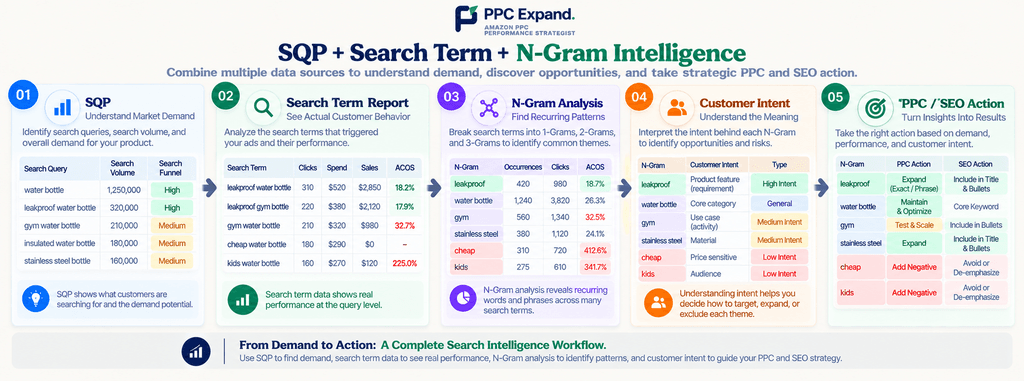
N-Gram analysis becomes even more powerful when combined with Amazon Search Query Performance.
SQP can help identify search demand and product-level search-funnel performance.
N-Gram analysis can identify recurring language patterns inside PPC search-term data.
Together, they can answer different questions:
| Dataset | Primary Question |
|---|---|
| SQP | What search queries and demand patterns matter for the product? |
| Search Term Report | Which customer searches interacted with our advertising? |
| N-Gram Analysis | Which words and phrases repeatedly appear across those searches? |
| Targeting Report | How are our selected targets performing? |
This creates a more complete search-intelligence system.
A Practical N-Gram Analysis Workflow
For an advanced PPC account, the process can be structured as follows:
- Collect: Export relevant search-term data.
- Clean: Remove unnecessary characters and normalize the dataset.
- Tokenize: Break search terms into 1-Grams, 2-Grams, and 3-Grams.
- Aggregate: Calculate clicks, spend, sales, orders, ACOS, and other metrics by N-Gram.
- Segment: Separate branded, non-branded, competitor, and irrelevant themes where appropriate.
- Identify winners: Find N-Grams associated with strong commercial performance.
- Identify losers: Find N-Grams associated with recurring waste.
- Validate: Review the individual search terms behind each pattern.
- Cross-check: Compare with SQP and other keyword research data.
- Act: Harvest, expand, optimize, monitor, or negative-target where justified.
- Measure: Evaluate the account-level impact after changes.
Building an Advanced N-Gram Dashboard
A practical N-Gram dashboard can include the following columns:
| Column | Purpose |
|---|---|
| N-Gram | The recurring word or phrase |
| N-Gram Type | 1-Gram, 2-Gram, 3-Gram, etc. |
| Occurrences | Number of search terms containing the N-Gram |
| Impressions | Total exposure associated with the N-Gram |
| Clicks | Total traffic |
| Spend | Total advertising cost |
| Orders | Attributed purchases |
| Sales | Attributed sales |
| CTR | Engagement signal |
| CVR | Conversion signal |
| CPC | Traffic cost |
| ACOS | Advertising efficiency |
| ROAS | Revenue generated per advertising dollar |
| Action | Strategic decision |
How to Prioritize N-Grams
Not every N-Gram deserves the same level of attention.
A practical prioritization framework can classify them into four groups:
| Category | Typical Signal | Potential Action |
|---|---|---|
| Profitable Theme | Strong sales and acceptable economics | Expand / harvest |
| Emerging Theme | Promising performance but limited data | Monitor / test |
| Waste Theme | Meaningful spend with weak results | Investigate / optimize |
| Irrelevant Theme | Consistent mismatch with product intent | Consider negative targeting |
This prevents the analysis from becoming a giant list of statistics without a decision framework.
Do Not Judge N-Grams Without Context
An N-Gram is only a pattern.
Its meaning depends on the search terms where it appears.
For example, the word:
“steel”
could appear in:
- stainless steel water bottle
- steel sports bottle
- steel bottle for gym
But it could also appear in:
- steel bottle replacement part
- steel bottle accessories
The same N-Gram can therefore represent very different customer intents.
Always drill down from N-Gram → Search Term → Campaign → Product → Business Objective.
N-Gram Analysis for Large Amazon PPC Accounts
N-Gram analysis becomes increasingly valuable as account complexity increases.
For a small account with a few hundred search terms, manual review may be sufficient.
For a large account containing:
- Multiple products
- Multiple marketplaces
- Hundreds of campaigns
- Thousands of keywords
- Large advertising budgets
- High search-term volume
pattern-based analysis can save significant analytical time.
Instead of reviewing every query manually, an analyst can use N-Grams to identify the areas that deserve deeper investigation.
N-Gram Analysis by Product or ASIN
Another important consideration is segmentation.
Do not automatically combine every product’s search terms into one N-Gram dataset.
A term can be highly profitable for one ASIN and irrelevant for another.
Consider analyzing N-Grams by:
- Parent ASIN
- Child ASIN
- Product category
- Campaign
- Marketplace
- Brand
- Product lifecycle stage
This creates more meaningful comparisons.
N-Gram Analysis by Campaign Type
You can also compare patterns across different campaign roles.
| Campaign Type | N-Gram Analysis Purpose |
|---|---|
| Automatic | Discover emerging search themes |
| Broad | Identify keyword expansion patterns |
| Phrase | Analyze related query variations |
| Exact | Evaluate proven keyword themes |
| Branded | Understand brand-intent patterns |
| Competitor | Analyze competitor-related search behavior |
This can help determine whether a pattern is primarily a discovery signal or an established scaling opportunity.
How N-Gram Analysis Can Improve Budget Allocation
Suppose two keyword themes consume similar amounts of budget.
| Theme | Spend | Sales | ACOS |
|---|---|---|---|
| leakproof | $2,000 | $9,500 | 21.1% |
| cheap | $2,000 | $450 | 444.4% |
The account may have a strong case for investigating whether budget and targeting should be shifted away from the weaker theme and toward the stronger opportunity.
However, budget decisions should also consider:
- Available search demand
- Marginal performance
- Inventory
- Profitability
- Business objectives
- Incremental growth potential
N-Gram analysis provides evidence for the decision; it does not make the decision automatically.
Advanced N-Gram Analysis: Separate Brand From Generic Demand
Branded and non-branded traffic can behave very differently.
For example, an N-Gram such as your brand name may have:
- Very high conversion
- Very low ACOS
- High CTR
That does not necessarily mean branded demand is a scalable acquisition opportunity.
Likewise, a generic N-Gram may have a higher ACOS but represent a much larger customer-acquisition opportunity.
Therefore, segment N-Gram analysis into:
- Branded
- Non-branded
- Competitor
- Product-specific
- Use-case-specific
Then compare performance within the appropriate context.
Advanced N-Gram Analysis: Search Intent Clusters
One of the most useful extensions is grouping N-Grams by intent.
| Intent Cluster | Example N-Grams | Potential Strategic Use |
|---|---|---|
| Material | stainless steel, glass, plastic | Product attribute analysis |
| Feature | leakproof, insulated, straw | Feature-based keyword expansion |
| Use case | gym, hiking, travel | Audience and use-case expansion |
| Price | cheap, budget, affordable | Price-intent analysis |
| Audience | kids, women, men | Customer-segment analysis |
| Accessory | replacement, lid, cap | Potential product-intent mismatch |
This converts a raw N-Gram report into a customer-intent map.
N-Gram Analysis Mistakes to Avoid
1. Looking Only at Frequency
A frequently occurring N-Gram is not necessarily profitable or strategically valuable.
2. Looking Only at ACOS
Aggregate ACOS can hide meaningful differences in traffic volume, conversion, and business value.
3. Negative-Targeting Entire Themes Too Quickly
A poor aggregate N-Gram may contain profitable combinations. Always inspect the underlying search terms.
4. Ignoring Product Segmentation
The same N-Gram can mean different things for different ASINs.
5. Ignoring Brand Intent
Branded terms can distort aggregate performance if mixed with generic search behavior.
6. Ignoring Search Volume
A highly efficient N-Gram may have limited room to scale if demand is small.
7. Treating N-Grams as Keywords Automatically
An N-Gram is an analytical pattern. It may become a keyword, but it first needs relevance and performance validation.
8. Making Decisions From Tiny Samples
Small samples can create extreme-looking ACOS or conversion rates that are not yet reliable enough for aggressive changes.
A Practical PPC Expand N-Gram Analysis Framework
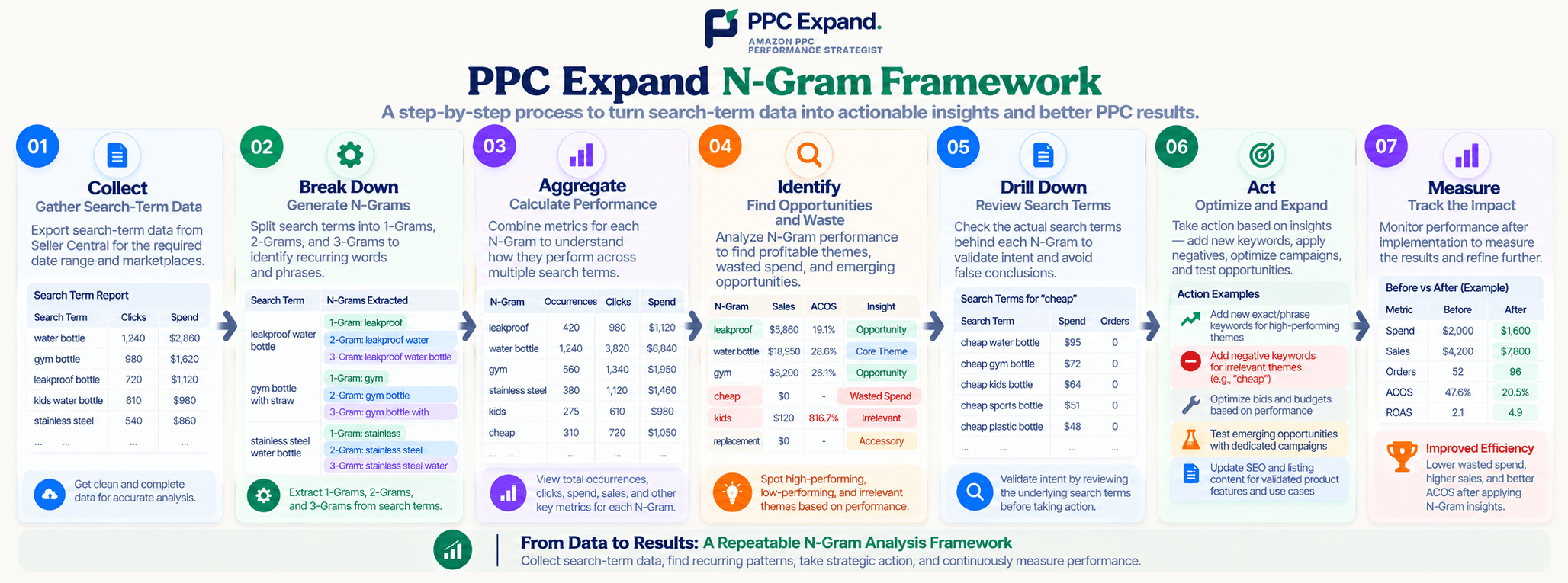
The PPC Expand approach can be structured into seven stages:
- Collect: Gather clean search-term data.
- Break Down: Generate 1-Gram, 2-Gram, and 3-Gram datasets.
- Aggregate: Calculate performance metrics for each N-Gram.
- Identify: Find recurring profitable and unprofitable patterns.
- Drill Down: Review the search terms behind each pattern.
- Act: Expand, harvest, optimize, monitor, or negative-target where justified.
- Measure: Track the impact at campaign and account level.
The framework can be summarized as:
Search Terms → N-Grams → Patterns → Intent → Action → Measurement
How N-Gram Analysis Fits Into the PPC Expand System
At this point, the first five articles in the PPC Expand content system connect naturally:
| Article | Primary Question |
|---|---|
| Article 1: SQP Complete Guide | What is happening across Amazon search? |
| Article 2: SQP for PPC Optimization | How can SQP improve PPC decisions? |
| Article 3: SQP Keyword Research | Which search opportunities should we investigate? |
| Article 4: Search Term Mining | Which customer searches should become deliberate targets? |
| Article 5: N-Gram Analysis | Which recurring patterns are driving opportunity or waste? |
This creates a complete search-intelligence progression:
Demand → Opportunity → Search Terms → Patterns → Keywords → Campaign Action
Final Takeaway
N-Gram analysis gives Amazon PPC analysts a way to see beyond individual search queries.
Instead of reviewing every search term as an isolated event, you can identify recurring patterns that reveal:
- Where customers are finding value
- Where advertising spend is being wasted
- Which product features generate demand
- Which customer segments are converting
- Which themes deserve keyword expansion
- Which patterns may require negative targeting
- Which search behaviors should influence campaign structure
The most important principle is simple:
N-Gram analysis should help you find the pattern. Search-term analysis should help you validate the pattern.
When the two are combined with SQP, keyword research, and campaign-level performance data, N-Gram analysis becomes much more than a reporting technique.
It becomes a repeatable system for discovering profitable keyword themes, controlling wasted spend, and continuously improving Amazon PPC campaign structure.
Frequently Asked Questions
What is an N-Gram in Amazon PPC?
An N-Gram is a sequence of one or more words extracted from customer search terms. In Amazon PPC analysis, N-Grams can be used to identify recurring words and phrases and evaluate their aggregate advertising performance.
What is the difference between a 1-Gram and a 2-Gram?
A 1-Gram contains one word, such as “leakproof.” A 2-Gram contains two words, such as “leakproof bottle.” Larger N-Grams provide more context but usually occur less frequently.
Can N-Gram analysis find negative keywords?
Yes. N-Gram analysis can identify recurring words or phrases associated with poor or irrelevant search behavior. However, the underlying search terms should be reviewed before applying negative targeting.
Can N-Gram analysis find new keywords?
Yes. Profitable N-Grams can reveal recurring customer-intent themes that may justify additional keyword research, phrase targeting, or exact-match keyword expansion.
What metrics should I use for N-Gram analysis?
Useful metrics include occurrences, impressions, clicks, spend, orders, sales, CTR, conversion rate, CPC, ACOS, ROAS, and cost per order.
Should I analyze 1-Grams, 2-Grams, and 3-Grams?
For most advanced analyses, using multiple N-Gram levels is useful. 1-Grams reveal broad themes, 2-Grams provide additional context, and 3-Grams can expose more specific customer-intent patterns.
Can N-Gram analysis replace search-term analysis?
No. N-Gram analysis is a pattern-detection method. Search-term analysis is still necessary to validate the individual queries behind the pattern and determine the appropriate campaign action.
Can N-Gram analysis be combined with Amazon SQP?
Yes. SQP can provide search-query and funnel insights, while N-Gram analysis can identify recurring language patterns within PPC search data. Combining the two can create a broader keyword and search-intelligence workflow.