

Amazon Search Query Performance (SQP) can be much more than a reporting dashboard. Used correctly, it can become a powerful keyword research system for Amazon PPC and SEO.
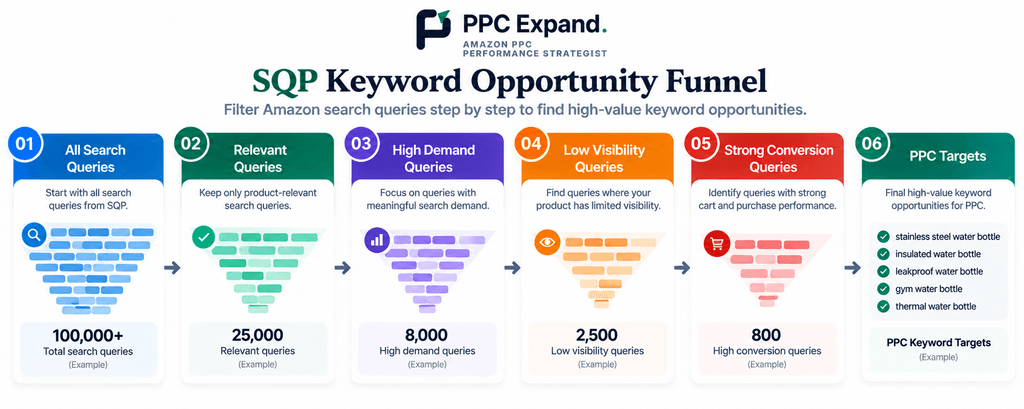
Instead of relying only on traditional keyword research tools, SQP allows you to analyze the search queries customers use and understand how your product performs throughout the search funnel—from impressions and clicks to cart adds and purchases.
The real opportunity is finding search queries where customer demand is meaningful, your product has limited visibility, and purchase performance shows potential.
In this guide, we’ll walk through how to use Amazon SQP for keyword research, how to identify hidden opportunities, how to validate those opportunities with PPC data, and how to turn them into actionable PPC and SEO strategies.
What Is Amazon SQP Keyword Research?
Amazon SQP keyword research is the process of analyzing Search Query Performance data to identify relevant customer search queries that may represent opportunities for PPC growth, organic visibility, or both.
Traditional keyword research often starts with keyword databases, estimated search volume, competitor analysis, and keyword variations. SQP adds another layer by connecting search queries with how your product actually performs within Amazon’s search funnel.
This allows you to investigate questions such as:
- What are customers actually searching for?
- Which relevant queries have significant demand?
- Where does my product have limited visibility?
- Which queries generate clicks but relatively few purchases?
- Which queries show strong purchase performance?
- Which valuable queries have limited PPC coverage?
- Which search queries deserve additional PPC or SEO attention?
The goal is not to collect more keywords. The goal is to identify the right search opportunities.
Why Amazon SQP Can Reveal Hidden Keyword Opportunities
Amazon’s Search Query Performance reporting provides search-funnel information at the query level. Amazon describes SQP as a way to understand which queries led customers to a product and provides brand- and ASIN-level performance information for those queries.
This creates an important distinction between search demand and keyword opportunity.
A search query may have:
- High demand but low product visibility
- High visibility but weak purchase performance
- Strong clicks but weak cart activity
- Strong purchase performance but limited traffic
- Strong PPC performance but insufficient campaign coverage
Each situation requires a different response.
For keyword research, one of the most interesting patterns is:
High Demand + Low Visibility + Strong Purchase Performance = Potential Keyword Opportunity
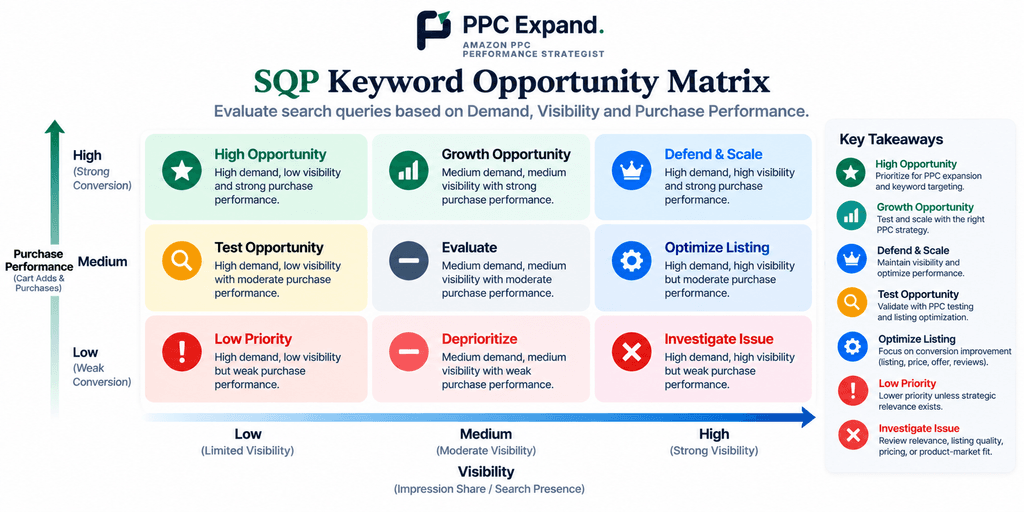
This does not automatically mean you should increase your PPC bids. It means the query deserves deeper investigation.
SQP Keyword Research vs. Traditional Amazon Keyword Research
Traditional keyword research and SQP keyword research should not be viewed as competing methods. They answer different questions and can work together.
| Traditional Keyword Research | SQP Keyword Research |
|---|---|
| Estimates or analyzes search demand | Analyzes Amazon search-query performance |
| Often starts with keyword databases | Starts with customer search behavior connected to your product |
| Helps discover potential keywords | Helps identify product-specific search opportunities |
| Often focuses on keyword volume and relevance | Can connect queries with search-funnel performance |
| Useful for broader market exploration | Useful for prioritizing opportunities based on actual product performance |
The strongest keyword research process can combine both approaches.
Use traditional keyword research to understand the broader market and discover potential terms. Then use SQP and PPC performance data to determine which opportunities deserve additional attention.
Step 1: Find High-Demand Search Queries
The first step is to identify search queries that demonstrate meaningful customer demand.
However, avoid the common mistake of assuming that the highest-volume query is automatically the best keyword opportunity.
Consider this illustrative example:
| Search Query | Demand | Relevance | Research Priority |
|---|---|---|---|
| stainless steel water bottle | High | High | High |
| insulated water bottle | High | High | High |
| kids water bottle | High | Low | Low |
The third query may have significant demand, but if the product is not designed for children, that demand does not necessarily represent a valuable opportunity.
Demand alone does not make a keyword valuable. Relevance comes first.
Step 2: Filter Search Queries by Product Relevance
Before evaluating PPC potential, classify search queries according to how closely they match the product and customer intent.
Highly Relevant Queries
These directly describe the product, its features, materials, use case, or intended customer.
Potentially Relevant Queries
These are related to the product but require additional investigation before becoming PPC targets.
Irrelevant Queries
These do not represent realistic customers for the product and should generally not be prioritized.
This filtering step is important because keyword research can easily become a volume exercise. A large keyword list is not necessarily a valuable keyword strategy.
Step 3: Look for High-Demand, Low-Visibility Queries
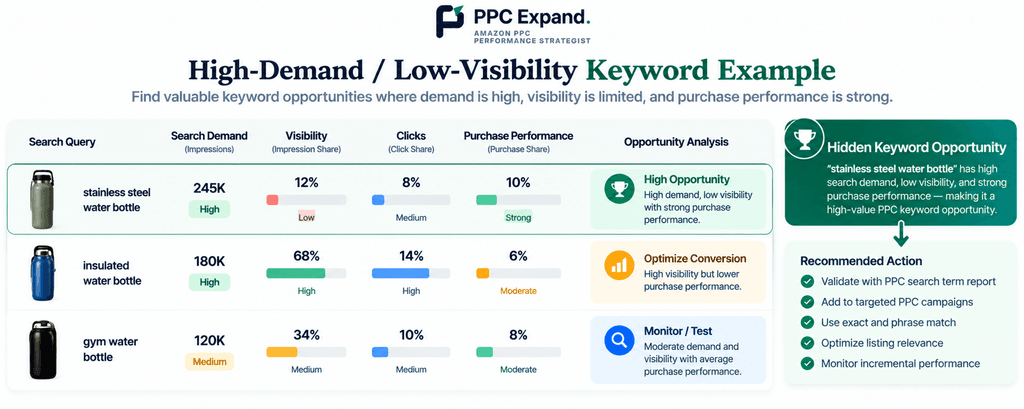
After identifying relevant search queries, the next step is to evaluate visibility.
A particularly interesting opportunity occurs when a query has meaningful demand but your product captures relatively little visibility.
| Search Query | Demand | Visibility | Purchase Performance |
|---|---|---|---|
| stainless steel water bottle | High | Low | Strong |
| insulated water bottle | High | High | Weak |
The first query deserves further investigation because there appears to be a visibility gap while purchase performance remains relatively strong.
That is very different from a query where visibility is already high and conversion is weak.
Step 4: Evaluate Click Performance
Visibility is only the beginning of the search funnel.
Once shoppers encounter your product, the next question is whether they engage with it.
Depending on the available data, evaluate signals such as:
- Impressions
- Click share
- Clicks
- Click-through behavior
- Search relevance
A query with low visibility but strong click performance can indicate that the product performs well when shoppers actually encounter it.
That can make the visibility gap more interesting.
Step 5: Analyze Cart and Purchase Performance
This is where SQP becomes especially useful for keyword prioritization.
Instead of asking only:
“Do shoppers click?”
Ask:
“What happens after they click?”
A query that produces strong purchase performance may deserve additional investigation even when the product currently has limited visibility.
On the other hand, a query with high visibility and strong clicks but weak purchase performance may require a different diagnosis.
The problem could be related to:
- Product listing quality
- Pricing
- Offer competitiveness
- Reviews and ratings
- Product-market fit
- Customer intent mismatch
In that situation, simply increasing PPC traffic may not address the underlying issue.
Step 6: Identify the Underpenetrated Keyword
An underpenetrated keyword is a search query where there appears to be room for the product to capture more of the available opportunity.
A practical pattern to investigate is:
- High demand
- Low visibility
- Strong engagement
- Strong purchase performance
- Limited PPC coverage
When several of these signals align, the query becomes a strong candidate for deeper PPC analysis.
Again, this is an opportunity signal—not an instruction to increase bids automatically.
Example: Finding a Hidden Keyword Opportunity
Imagine a water bottle ASIN has the following illustrative SQP results:
| Search Query | Search Demand | Visibility | Purchase Performance | Potential Action |
|---|---|---|---|---|
| stainless steel water bottle | 245K | 12% | 10% | Investigate PPC expansion |
| insulated water bottle | 180K | 68% | 6% | Diagnose conversion |
| gym water bottle | 120K | 34% | 8% | Monitor / test |
The first query stands out because demand is high, visibility is relatively low, and purchase performance is strong.
That combination suggests a potentially valuable opportunity to investigate whether additional PPC coverage could capture incremental demand.
Note: The numbers above are illustrative and are not Amazon benchmark data.
How to Validate an SQP Keyword Opportunity With PPC Data
SQP should not operate in isolation.
Once you identify a promising search query, compare it against your PPC advertising data.
Amazon’s Sponsored Products Search Term Report provides search-term performance data for terms that generated at least one ad click. The report can be used to identify high-performing searches and inform targeting and negative-targeting decisions.
For every promising SQP query, ask:
- Is the query already generating PPC impressions?
- Is it receiving clicks?
- How much have we spent on it?
- Has it generated sales?
- Which campaign is capturing it?
- Which match type is responsible?
- Is the query receiving enough budget?
- Is it already isolated as a high-value target?
This creates a bridge between search demand and PPC campaign coverage.
SQP Keyword Research Workflow
A practical SQP keyword research process can follow this sequence:
- SQP Data — Start with Search Query Performance data.
- Identify Relevant Search Opportunities — Filter queries by relevance and customer intent.
- Check Demand + Visibility + Purchase Performance — Identify potential gaps.
- Validate Against PPC Search Term Report — Determine whether PPC already captures the query.
- Evaluate Spend + Sales + ACOS / ROAS — Review advertising economics.
- Promote High-Value Query — Move validated opportunities into a deliberate targeting strategy.
- Exact / Phrase / Broad Campaign Strategy — Select the appropriate campaign structure.
- Measure Incremental Performance — Track what changed after the optimization.
Analyze → Optimize → Measure → Repeat.
SQP + Search Term Report: The Keyword Harvesting System
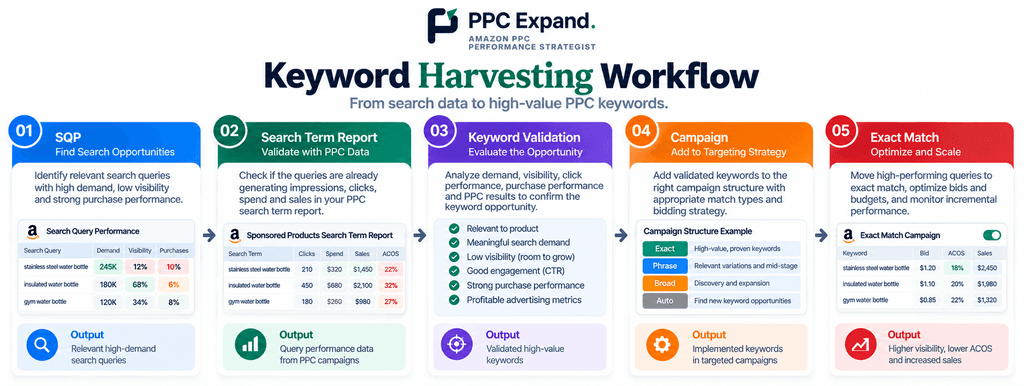
The combination of SQP and the PPC Search Term Report creates a more complete keyword discovery system.
SQP helps you identify potential search opportunities, while PPC search-term data helps validate how advertising performs against those searches.
The process can be summarized as:
- Discover: Find relevant search opportunities in SQP.
- Validate: Compare them against PPC search-term performance.
- Evaluate: Review spend, sales, ACOS, ROAS, and conversion signals.
- Promote: Move validated opportunities into appropriate campaigns.
- Measure: Determine whether the change creates meaningful incremental performance.
This approach helps prevent a common PPC problem: adding keywords simply because they have high search volume without understanding how the product performs for those searches.
When Should an SQP Query Become a PPC Keyword?
Not every SQP query needs to become a PPC keyword immediately.
A query becomes more attractive when several conditions align:
- Relevant: The query clearly represents the product.
- Demand exists: There is meaningful customer interest.
- Purchase behavior is healthy: Shoppers demonstrate commercial intent.
- Visibility is underdeveloped: There is room to capture more exposure.
- PPC coverage is limited: Existing campaigns are not sufficiently capturing the query.
- Economics make sense: Expected advertising performance fits the business objective.
Choosing the Right Match Type
Once a query has been validated, match type becomes a campaign-structure decision.
Amazon Sponsored Products supports broad, phrase, and exact keyword targeting, allowing advertisers to control the degree of matching between keywords and customer searches.
| Situation | Possible Approach |
|---|---|
| New opportunity with uncertain performance | Test through broader discovery targeting. |
| Relevant query with proven sales | Consider focused exact targeting. |
| Query has multiple valuable variations | Consider phrase or broad discovery alongside focused targets. |
| Query consistently fails performance goals | Review bids, relevance, campaign structure, or negative targeting. |
The exact campaign structure should depend on the account’s goals, budget, profitability requirements, and existing campaign architecture.
Using SQP for Amazon SEO Keyword Expansion
SQP insights can also support Amazon SEO.
If a relevant search query consistently demonstrates demand and meaningful shopper engagement, it may deserve consideration within the product-detail-page strategy.
Potential areas for evaluation include:
- Product title
- Bullet points
- Product description
- Backend search terms
- A+ Content where appropriate
The objective should not be keyword stuffing.
The objective is to make the product more relevant to the language customers actually use.
How to Find Keywords Your PPC Campaigns Are Missing
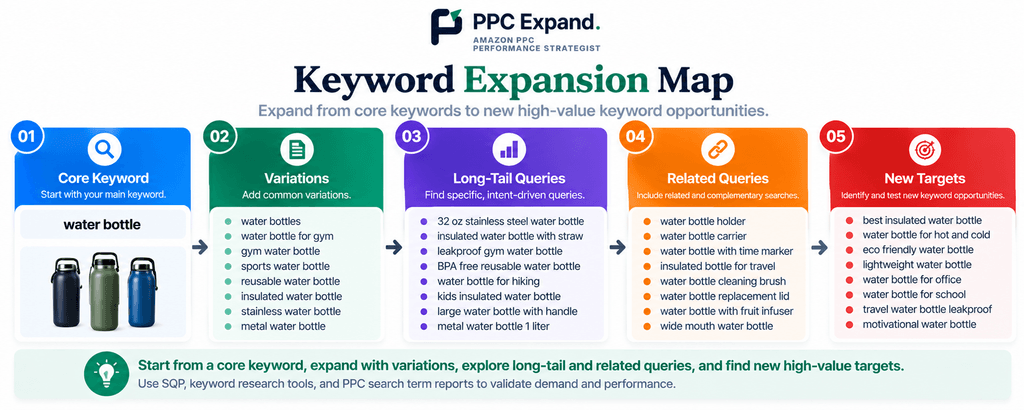
One of the most useful applications of SQP is identifying the difference between search opportunity and advertising coverage.
| SQP Opportunity | PPC Coverage | Interpretation |
|---|---|---|
| High | Low | Potential coverage gap |
| High | High | Optimize and defend performance. |
| Low | High | Review efficiency and relevance. |
| Low | Low | Usually lower priority. |
This comparison can help separate genuine keyword opportunities from queries that are already sufficiently covered.
Do Not Confuse Search Opportunity With Guaranteed Growth
A high-demand query with low visibility does not automatically mean that increasing PPC spend will generate profitable incremental sales.
You still need to evaluate:
- Product relevance
- Competitive environment
- Listing quality
- Pricing and offer
- Reviews and ratings
- Historical PPC performance
- Conversion behavior
- Profitability requirements
If visibility and clicks are already strong but purchase performance is weak, the bottleneck may be conversion rather than traffic.
A Practical SQP Keyword Opportunity Score
For large catalogs, manually reviewing thousands of search queries can become inefficient.
A simple internal prioritization framework can help organize the analysis:
Opportunity Priority = Relevance + Demand + Purchase Performance + Visibility Gap + PPC Coverage Gap
This is an internal decision-support framework, not an Amazon metric.
The exact weighting should depend on the account’s objectives, margins, competitive environment, product maturity, and growth strategy.
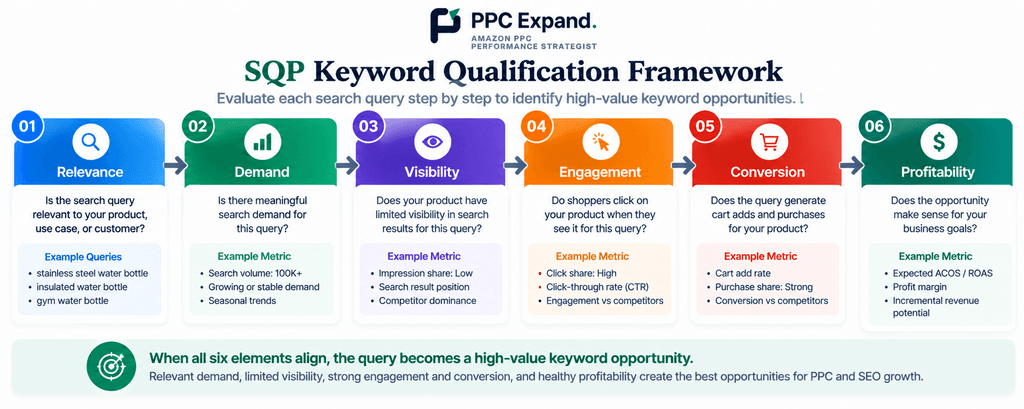
The PPC Expand SQP Keyword Research Framework

At PPC Expand, the process can be simplified into six core questions:
- Is there demand?
- Is the query relevant?
- How visible is the product?
- How do shoppers engage?
- Does the query produce purchase intent?
- Is PPC currently capturing enough of the opportunity?
This creates a structured path:
- Demand
- Relevance
- Visibility
- Engagement
- Purchase Performance
- PPC Coverage
- Keyword Action
- Measurement
The important point is that the process does not stop at keyword discovery. The keyword must be validated, strategically targeted, and measured.
Common SQP Keyword Research Mistakes
1. Choosing Keywords Based Only on Demand
High demand does not automatically mean high commercial value. A query must also be relevant to the product and customer intent.
2. Ignoring Relevance
A query can have enormous demand but still be unsuitable for your product.
3. Looking Only at Clicks
Clicks indicate engagement, but purchase behavior provides a stronger signal when evaluating commercial opportunity.
4. Increasing Bids Before Diagnosing the Funnel
If visibility is already strong but purchase performance is weak, additional traffic may not solve the underlying problem.
5. Ignoring Existing PPC Coverage
Before adding a new keyword, determine whether existing campaigns are already capturing the query.
6. Treating Every Query as a Keyword
Some queries should be targeted. Others should remain discovery data, require further validation, or may be candidates for negative targeting.
How Often Should You Perform SQP Keyword Research?
SQP keyword research works best as an ongoing process rather than a one-time exercise.
The ideal cadence depends on account size, sales velocity, seasonality, and how quickly the search landscape changes.
| Frequency | Recommended Focus |
|---|---|
| Weekly | Monitor important opportunities and major changes. |
| Biweekly | Review keyword harvesting and PPC campaign coverage. |
| Monthly | Perform deeper SQP opportunity analysis. |
| Quarterly | Reassess the broader keyword and category strategy. |
From Search Query to PPC Growth
The complete process can be summarized as:
- Review or export SQP data.
- Identify relevant high-demand queries.
- Find queries with limited visibility.
- Analyze click, cart, and purchase performance.
- Prioritize queries with strong commercial signals.
- Compare those queries against PPC search-term data.
- Identify campaign coverage gaps.
- Promote validated opportunities into the appropriate campaigns.
- Optimize bids, budgets, match types, and campaign structure.
- Measure whether the change creates meaningful incremental performance.
Frequently Asked Questions
What is an SQP keyword opportunity?
An SQP keyword opportunity is a relevant customer search query that shows meaningful demand and commercial potential while your product has room to improve visibility or PPC coverage.
Can SQP replace traditional keyword research tools?
No. SQP and traditional keyword research serve different purposes. SQP provides product-specific search-funnel insights, while other keyword research methods can help discover broader market opportunities.
How do I turn an SQP query into a PPC keyword?
First validate relevance, demand, purchase performance, existing PPC coverage, and economics. If the query meets your criteria, add it to the campaign structure that best matches your targeting strategy.
Can SQP help with Amazon SEO?
Yes. Relevant customer search queries can provide useful language for evaluating product-detail-page content. The data should be used to improve relevance rather than to stuff keywords into the listing.
Should every high-demand SQP query be targeted?
No. Demand should be evaluated alongside relevance, visibility, engagement, purchase performance, competition, and profitability.
What is the most important SQP keyword opportunity?
There is no universal single metric. A particularly interesting pattern is a relevant query with meaningful demand, limited visibility, strong purchase performance, and insufficient PPC coverage.
Final Takeaway
Amazon SQP can turn keyword research from a simple list-building exercise into a performance-driven opportunity analysis.
The goal is not to find the largest possible number of keywords.
The goal is to identify the queries where demand, relevance, visibility, engagement, purchase performance, and PPC coverage tell a compelling story.
Discover → Validate → Prioritize → Target → Optimize → Measure
When those signals align, an SQP query can move from search data into a structured PPC and SEO strategy.
That is where SQP becomes more than a report—it becomes part of a repeatable Amazon PPC keyword research system.
Related PPC Expand Resources
- Amazon Search Query Performance Report: Complete Guide
- How to Use Amazon Search Query Performance for PPC Optimization
- Amazon Search Term Report: Complete Guide for PPC Optimization