

Amazon PPC can generate significant sales, but not every click contributes equally to growth.
Some clicks come from highly relevant searches and eventually generate profitable orders. Others consume budget without producing meaningful results. Some search terms are irrelevant. Some keywords attract expensive traffic but fail to convert. Some campaigns compete against each other. And sometimes the problem is not the targeting at all—it may be the product detail page, offer, pricing, reviews, or conversion rate.
That is why reducing Amazon PPC wasted ad spend is not simply a matter of adding negative keywords.
A strong optimization process looks at the entire advertising system:
- Search terms
- Keywords and match types
- Automatic targeting
- Product targeting
- Negative targeting
- Bids
- Placements
- Campaign structure
- Keyword cannibalization
- Search intent
- Conversion performance
- N-Gram patterns
- Budget allocation
Amazon itself provides advertisers with automatic, manual, and negative targeting options for Sponsored Products. Its Search Term Report can also be used to identify customer searches and find search terms that may require new targeting or negative targeting.
This guide explains how to systematically find where PPC money is being wasted—and what to do about it.
What Is Amazon PPC Wasted Ad Spend?
Amazon PPC wasted ad spend is advertising spend that does not produce enough business value relative to the objective of the campaign.
In the simplest example, an advertiser may spend $100 on clicks and generate no sales. That is an obvious form of wasted spend.
But wasted spend is not always that obvious.
| Situation | Potential Waste | Why It Matters |
|---|---|---|
| Irrelevant search term | Clicks with little product relevance | Budget is reaching the wrong audience |
| High-spend, no-order search term | Spend without attributed sales | May indicate poor intent or weak conversion |
| High ACOS target | Spend generating inefficient sales | Can reduce account profitability |
| Duplicate targeting | Multiple campaigns pursue similar traffic | Can make budget allocation and optimization harder |
| Weak placement economics | Expensive traffic with poor return | May require bid or placement adjustments |
| Poor product targeting | Clicks from unsuitable ASINs or categories | Traffic may have weak purchase intent |
| Low-converting traffic | Clicks without sufficient conversion | May indicate listing or offer problems |
The important distinction is this:
Wasted spend is a symptom. The optimization process needs to identify the reason behind the waste.
Why Reducing Wasted Spend Is More Than Lowering ACOS
ACOS is useful, but ACOS alone does not tell you exactly where money is being wasted.
Two campaigns can have the same ACOS while having completely different underlying problems.
| Campaign | Spend | Sales | ACOS | Possible Diagnosis |
|---|---|---|---|---|
| Campaign A | $1,000 | $3,000 | 33.3% | Efficient traffic with room for scale |
| Campaign B | $1,000 | $3,000 | 33.3% | Large amount of waste offset by a few strong targets |
The account-level ACOS is identical, but the optimization opportunity is completely different.
This is why experienced PPC analysis goes below campaign-level metrics.
You need to understand which search terms, targets, products, placements, and patterns are consuming the budget.
The Amazon PPC Wasted Spend Funnel

A useful way to think about wasted spend is as a funnel:
- Impressions — Is Amazon showing the ad to relevant shoppers?
- Clicks — Are shoppers interested enough to click?
- Spend — How much budget is being consumed?
- Orders — Are clicks converting?
- Sales — Is the generated revenue economically attractive?
- Profitability — Does the traffic support the business objective?
Each stage can reveal a different type of inefficiency.
1. Start With the Search Term Report
The Search Term Report is one of the most useful places to investigate wasted Sponsored Products spend.
Amazon describes Search Term Reports as showing the search terms customers use to look for products, or terms inferred as best matches in certain non-search contexts. For Sponsored Products, the report includes search terms that generated at least one ad click. Amazon also specifically recommends using search-term data to identify high-performing searches and create negative keyword or product targets for searches that do not meet campaign goals.
This makes the search-term report a natural starting point for waste analysis.
What to look for
- High spend with zero orders
- High clicks with zero orders
- Extremely high ACOS
- Irrelevant searches
- Low-intent searches
- Queries with poor conversion
- Repeated poor-performing terms
- Search terms appearing across multiple campaigns
- Search terms that should be promoted into dedicated targeting
Do not immediately negative every search term with poor performance. First determine whether the problem is relevance, insufficient data, bid level, listing conversion, price, competition, or another factor.
2. Find High-Spend, Zero-Sales Search Terms
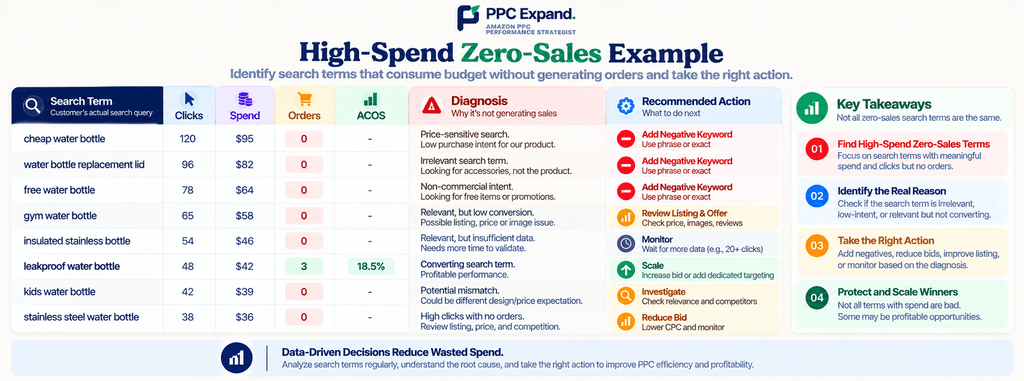
This is one of the most obvious waste patterns.
| Search Term | Clicks | Spend | Orders | Sales | ACOS | Initial Review |
|---|---|---|---|---|---|---|
| cheap plastic water bottle | 120 | $95 | 0 | $0 | — | Investigate |
| stainless steel water bottle | 85 | $72 | 6 | $360 | 20.0% | Scale candidate |
| water bottle replacement lid | 74 | $61 | 0 | $0 | — | Review relevance |
| insulated gym bottle | 48 | $44 | 3 | $180 | 24.4% | Monitor |
Illustrative data only. These figures are examples, not Amazon benchmarks.
The first and third search terms deserve investigation, but they do not automatically require the same action.
If “cheap plastic water bottle” is fundamentally inconsistent with the product, negative targeting may make sense.
If “water bottle replacement lid” is relevant to the category but the advertised product does not include a replacement lid, the same conclusion may apply—but the reasoning is different.
The goal is not simply to find expensive clicks. The goal is to understand why those clicks happened and whether they should happen again.
3. Analyze Spend Before You Analyze ACOS
ACOS can be misleading when there are no sales.
A search term with:
- $2 spend
- 3 clicks
- 0 orders
does not necessarily deserve the same attention as one with:
- $150 spend
- 90 clicks
- 0 orders
Both have no sales, but the second search term has consumed significantly more evidence and budget.
A useful waste-analysis dashboard should therefore include:
- Clicks
- Spend
- Orders
- Sales
- ACOS
- Conversion rate
- CPC
- Search-term relevance
- Intent
- Campaign source
4. Don’t Confuse Low Conversion With Irrelevance
This distinction is critical.
A search term can be highly relevant to the product and still convert poorly.
For example:
A shopper searches for “stainless steel water bottle,” clicks your product, but does not purchase.
That does not automatically mean the keyword is bad.
The shopper may have rejected the product because of:
- Price
- Reviews
- Product images
- Product features
- Shipping expectations
- Competitor offers
- Product detail page messaging
- Variation selection
- Brand preference
Negative targeting would remove the traffic, but it would not solve the underlying conversion problem.
Before excluding relevant traffic, ask:
Is the traffic bad, or is the offer failing to convert good traffic?
5. Use Search Intent to Diagnose Waste
Not every search containing your main keyword represents the same customer intent.
| Search Term | Likely Intent | Potential Issue |
|---|---|---|
| stainless steel water bottle | Core category | Highly relevant |
| leakproof stainless steel water bottle | Feature-specific | Potentially valuable |
| water bottle for hiking | Use-case | Depends on product positioning |
| cheap water bottle | Price-sensitive | Potential mismatch |
| replacement water bottle lid | Accessory/replacement | Potential mismatch |
| water bottle DIY | Informational | Potentially poor commercial intent |
Intent analysis makes negative targeting more intelligent.
6. Find Recurring Waste With N-Gram Analysis
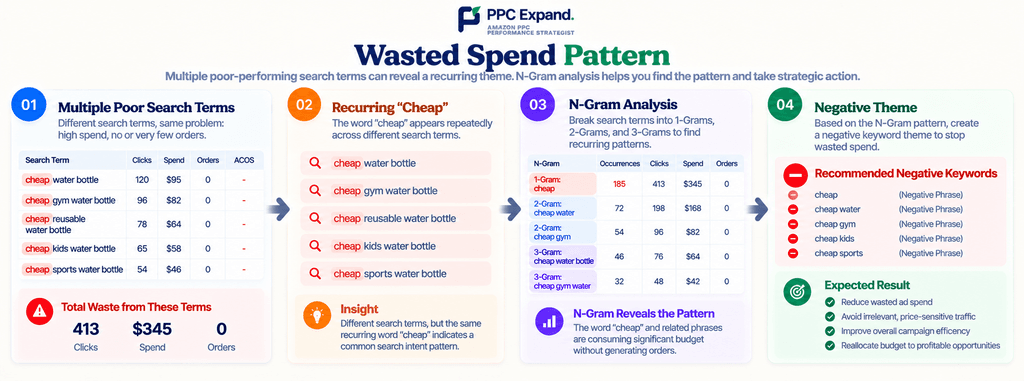
Looking at search terms individually is useful, but large accounts can contain thousands of queries.
This is where N-Gram analysis becomes powerful.
N-Gram analysis breaks customer search terms into recurring components:
- 1-Gram: Individual words
- 2-Gram: Two-word combinations
- 3-Gram: Three-word combinations
For example:
| Search Term | 1-Gram | 2-Gram | 3-Gram |
|---|---|---|---|
| cheap stainless steel water bottle | cheap | cheap stainless | cheap stainless steel |
| cheap gym water bottle | cheap | cheap gym | cheap gym water |
| cheap reusable water bottle | cheap | cheap reusable | cheap reusable water |
If “cheap” repeatedly appears in poor-performing search terms, the problem may not be one keyword.
It may be a recurring search-intent pattern.
That is the real value of N-Gram analysis: it can reveal patterns that are difficult to see when reviewing search terms one by one.
7. Wasted Spend Pattern: Recurring Negative Themes
Imagine the account has these search terms:
- cheap plastic water bottle
- cheap water bottle for gym
- cheap reusable water bottle
- cheap kids water bottle
- cheap sports water bottle
Each search term is different.
But N-Gram analysis reveals the same recurring word:
cheap
If these queries collectively consume significant spend and generate little or no sales, the recurring theme deserves investigation.
Instead of treating five search terms as five isolated problems, the analyst can investigate whether the underlying price-sensitive intent is incompatible with the product’s positioning.
This is a more scalable approach to wasted-spend analysis.
8. Don’t Automatically Negative Every Poor N-Gram
N-Gram analysis is a diagnostic tool—not an automatic negative-keyword generator.
A word can appear in both profitable and unprofitable searches.
For example, consider the word:
premium
It could appear in:
- premium stainless steel bottle
- premium insulated bottle
- premium gym water bottle
If those searches generate sales, “premium” should not be treated as wasted traffic simply because it appears frequently.
Always evaluate:
- Occurrences
- Clicks
- Spend
- Orders
- Sales
- ACOS
- Conversion rate
- Search-term relevance
- Search intent
Then drill back into the underlying search terms before taking action.
9. Use N-Gram Analysis to Find Hidden Keyword Opportunities
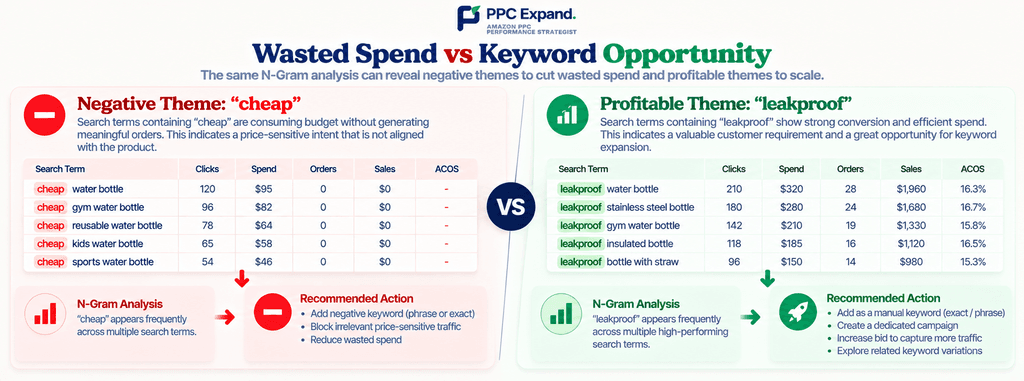
N-Gram analysis is not only about reducing waste.
It can also uncover profitable keyword themes.
Suppose several converting search terms contain the word:
- leakproof water bottle
- leakproof stainless steel bottle
- leakproof gym water bottle
- leakproof insulated bottle
- leakproof bottle with straw
The recurring word leakproof may represent a meaningful customer requirement.
The analyst can then investigate keyword expansion opportunities around that theme.
| Recurring Theme | Example Opportunity | Possible Action |
|---|---|---|
| leakproof | leakproof water bottle | Keyword expansion |
| leakproof | leakproof stainless steel bottle | Keyword expansion |
| leakproof | leakproof gym bottle | Test relevant targeting |
This demonstrates an important principle:
The same analysis that finds wasted spend can also reveal where additional profitable demand may exist.
10. Review Automatic Campaigns for Waste and Discovery
Automatic targeting can be valuable for both discovery and reach. Amazon describes automatic targeting as a way to match ads to keywords and products based on shopping queries and product information, and notes that it can help advertisers discover search trends and keywords for manual campaigns.
But automatic campaigns can also generate traffic that requires ongoing evaluation.
Review the performance of the different automatic targeting groups and the search terms they generate.
Look for:
- High-spend search terms
- Irrelevant searches
- Poor-converting themes
- Repeated search-term patterns
- Product targets with weak performance
- Opportunities worth moving into manual targeting
Automatic campaigns should not necessarily be treated as waste simply because they are broad.
They can serve a strategic purpose:
Discovery → Data → Validation → Manual targeting → Optimization
11. Control Waste With Negative Keywords
Negative targeting is one of the most direct tools for controlling unwanted traffic.
Amazon states that negative targeting can exclude keywords, products, or brands that do not meet campaign objectives. Amazon also describes negative keywords as a way to prevent ads from appearing for shopping results that do not meet performance goals.
Before adding a search term as a negative, work through the decision process below. The goal is to distinguish irrelevant traffic from relevant traffic that simply needs more data, a lower bid, or a conversion-focused investigation.
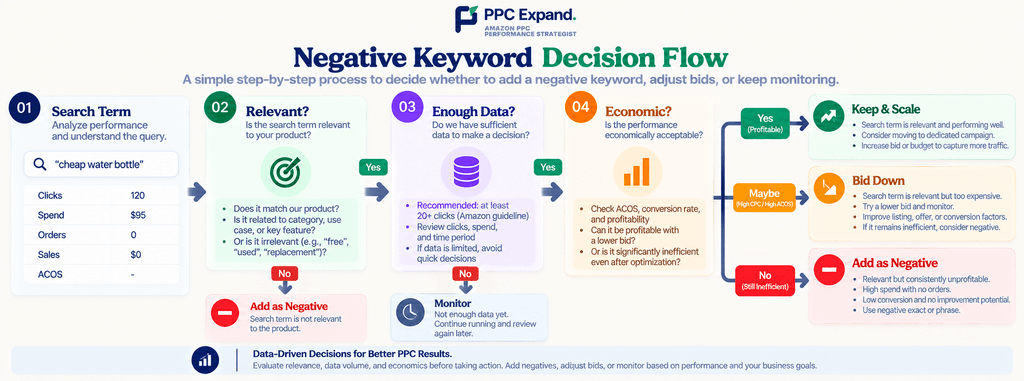
Negative targeting can be used for two broad reasons
Relevance-based negatives
The search is fundamentally incompatible with the product.
Example:
- replacement parts
- DIY
- free
- used
Whether these should be negative depends on the actual product and business model.
Performance-based negatives
The search may be relevant, but the accumulated performance does not justify continuing to spend at the current level.
Amazon recommends evaluating a keyword’s performance after at least 20 clicks before deciding whether to add it as a negative target. This is an Amazon recommendation, not a universal rule for every account or situation.
12. Negative Phrase vs Negative Exact
Choosing the correct negative match type matters.
Amazon supports negative phrase and negative exact matching for Sponsored Products. Negative phrase can prevent ads from showing for shopping queries containing the complete phrase or close variations, while negative exact is more restrictive.
| Situation | Potential Approach |
|---|---|
| A recurring unwanted theme appears across variations | Consider negative phrase |
| One specific search term is consistently poor | Consider negative exact |
| Only one variation is problematic | Investigate exact-level control |
| Theme is still producing profitable traffic | Do not automatically negative |
The goal is to remove unwanted traffic without accidentally blocking valuable searches.
13. Product Targeting Can Also Create Wasted Spend
Wasted spend is not limited to keyword campaigns.
Product targeting can generate clicks from specific ASINs, categories, or related products that may not produce acceptable results.
Amazon recommends reviewing product-targeting performance and allows advertisers to add negative product targets to exclude products or brands that do not meet campaign goals.
Analyze:
- Target ASIN
- Clicks
- Spend
- Orders
- Sales
- ACOS
- Conversion rate
- Price relationship
- Review relationship
- Product relevance
A product target that receives significant clicks but consistently fails to convert may deserve deeper investigation or exclusion.
14. Watch for Campaign Cannibalization
Another source of inefficiency is excessive overlap between campaigns.
For example, the same search theme may appear through:
- Automatic targeting
- Broad match
- Phrase match
- Exact match
- Product targeting
This does not automatically mean Amazon is literally charging you against yourself or that every overlapping campaign is inherently wasteful.
The real problem is lack of strategic control.
If multiple campaigns are competing for similar traffic, it becomes harder to understand:
- Which campaign owns the keyword
- Where the strongest bid should be
- Where the budget should go
- Which campaign should be scaled
- Where negatives should be applied
A structured campaign architecture can make performance management much easier.
15. Match Types Can Influence Waste
Amazon Sponsored Products supports broad, phrase, and exact keyword match types. Match types help advertisers fine-tune which shopping queries their ads are eligible to show against.
| Match Type | General Role | Waste-Control Consideration |
|---|---|---|
| Broad | Discovery and reach | Requires search-term monitoring |
| Phrase | Controlled expansion | Monitor query variations |
| Exact | More controlled targeting | Useful for proven search terms |
Amazon’s own targeting guide describes broad as offering broader exposure, phrase as more restrictive, and exact as the most restrictive keyword match type.
A practical architecture can therefore use broader targeting for discovery while moving validated opportunities into more controlled targeting.
16. Don’t Ignore Bids When Investigating Wasted Spend
Sometimes the keyword is good but the bid is too aggressive.
Consider a highly relevant keyword that converts well but is being purchased at an uneconomical CPC.
That is not necessarily a negative-keyword problem.
It may be a bid optimization problem.
For every high-spend target, ask:
- Is the traffic relevant?
- Does it convert?
- What is the CPC?
- What is the target ACOS?
- What is the conversion rate?
- Is the current bid justified by the economics?
- Could the target remain profitable at a lower bid?
This distinction is important because removing a profitable keyword simply because its current ACOS is high may destroy future opportunity when a bid adjustment could have improved its economics.
17. Placement Performance Can Reveal Another Layer of Waste
Campaign-level performance can hide differences between placements.
If a campaign performs well overall but one placement generates significantly weaker economics, investigate the placement before making a campaign-wide decision.
Consider:
- Placement
- Spend
- Sales
- ACOS
- Conversion rate
- CPC
- Business objective
The correct action might be a bid or placement adjustment rather than a keyword negative.
18. Look for Expensive Clicks With Weak Conversion
High CPC can accelerate wasted spend.
For example:
| Target | Clicks | CPC | Spend | Orders |
|---|---|---|---|---|
| Keyword A | 30 | $0.80 | $24 | 4 |
| Keyword B | 30 | $2.50 | $75 | 1 |
Both targets received 30 clicks, but Keyword B consumed more than three times the budget.
This is why click volume alone is not enough for waste analysis.
19. Separate Relevance Waste From Economic Waste
This is one of the most useful frameworks for PPC optimization.
| Type of Waste | Question | Typical Direction |
|---|---|---|
| Relevance waste | Why are we showing for this search? | Negative / targeting refinement |
| Conversion waste | Why does relevant traffic fail to convert? | Listing / offer investigation |
| Bid waste | Are we paying too much for this traffic? | Bid optimization |
| Structural waste | Is the account poorly organized? | Campaign restructuring |
| Budget waste | Is money concentrated in weak opportunities? | Budget reallocation |
| Pattern waste | Is the same poor theme repeating? | N-Gram + negative analysis |
20. Build a Wasted Spend Dashboard
A serious Amazon PPC optimization system should make wasted spend easy to identify.
A useful dashboard can contain:
| Metric | Purpose |
|---|---|
| Search Term | Identify the actual customer query |
| Campaign | Identify where the traffic originated |
| Target | Identify the keyword or product target |
| Match Type | Understand targeting control |
| Clicks | Measure traffic volume |
| Spend | Quantify budget consumption |
| Orders | Measure conversion output |
| Sales | Measure revenue output |
| ACOS | Measure advertising efficiency |
| CVR | Measure conversion efficiency |
| CPC | Measure traffic cost |
| Intent | Classify customer demand |
| Action | Document the optimization decision |
21. Create a Waste Classification System
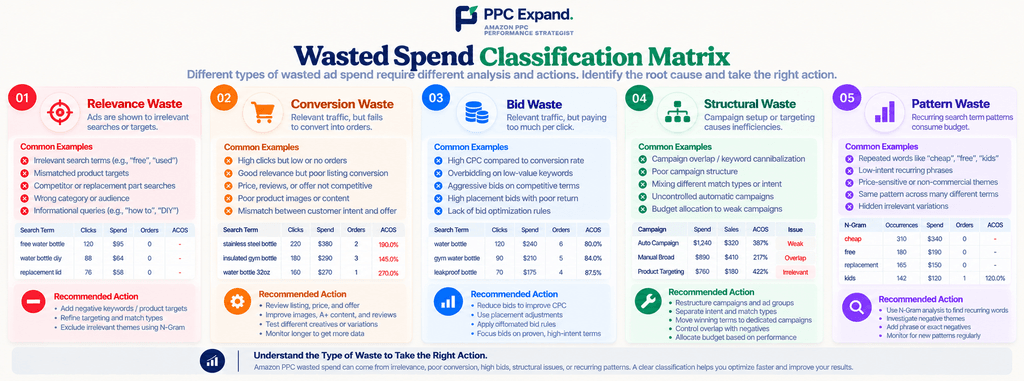
Instead of simply labeling everything as “bad,” classify the problem.
- NEGATIVE: Search or target should likely be excluded.
- BID DOWN: Relevant traffic, but economics require a lower bid.
- LISTING REVIEW: Relevant traffic but weak conversion may indicate a product-detail issue.
- HARVEST: Search term is performing well and may deserve dedicated targeting.
- MOVE: Opportunity should be transferred into a more controlled campaign.
- MONITOR: Insufficient evidence for a strong action.
- EXPAND: Strong pattern suggests additional relevant opportunities.
This makes optimization decisions more consistent and easier to audit.
22. Search Term Mining + N-Gram Analysis
Search-term analysis and N-Gram analysis should work together.
Search-term analysis asks:
“Which individual searches are producing this result?”
N-Gram analysis asks:
“What recurring words or phrases are behind these results?”
For example:
Search-term level:
- cheap plastic water bottle → $95 spend → 0 orders
- cheap gym water bottle → $72 spend → 0 orders
- cheap reusable water bottle → $64 spend → 0 orders
N-Gram level:
cheap → recurring poor-performing theme
This combination makes it easier to move from individual symptoms to a broader diagnosis.
23. SQP + Search Term + N-Gram Intelligence
Wasted-spend analysis becomes even more powerful when combined with Amazon Search Query Performance data.
The three datasets answer different questions.
| Data Source | Primary Question |
|---|---|
| SQP | What are customers searching for and how is the product performing through the search funnel? |
| Search Term Report | Which searches actually generated advertising clicks and performance? |
| N-Gram Analysis | Which recurring words and phrases appear across those searches? |
The combined workflow becomes:
SQP → Search Term Report → N-Gram → Intent → PPC / SEO Action
This allows an advertiser to distinguish between:
- High-demand opportunities
- Poorly covered demand
- Profitable search themes
- Wasted search themes
- Potential SEO opportunities
- Potential negative-targeting opportunities
24. Use Search-Term Performance to Harvest Winning Keywords
Reducing waste does not mean simply cutting spend.
Some of the most valuable optimization decisions involve moving budget away from weak traffic and toward proven traffic.
Amazon has introduced Target Promotion for Sponsored Products to help advertisers identify high-performing targets for further refinement and more efficient spend, while reducing spend on lower-performing targets.
A practical harvesting workflow can look like:
- Discover search term
- Validate relevance
- Review sales and conversion
- Assess economics
- Move into appropriate targeting
- Assign an appropriate bid
- Control unwanted overlap
- Measure incremental performance
25. Don’t Cut Spend Blindly
One of the biggest mistakes in PPC optimization is treating every reduction in spend as a success.
Suppose an account spends $10,000 and generates $30,000 in sales.
You aggressively remove $3,000 of spend.
The account now spends $7,000 and generates $18,000 in sales.
ACOS may look better, but the business lost $12,000 in attributed sales.
The objective should therefore not be:
“Spend less.”
It should be:
“Spend less on low-value traffic while protecting and expanding high-value traffic.”
26. Wasted Spend Optimization Should Follow the Business Objective
There is no universal acceptable ACOS.
A launch campaign may intentionally accept higher ACOS to generate visibility and collect data.
A mature product may prioritize contribution margin.
A ranking-focused campaign may have different economics from a profitability-focused campaign.
Therefore, before labeling spend as waste, define the campaign objective.
| Campaign Objective | What to Evaluate |
|---|---|
| Profitability | Contribution economics and efficient sales |
| Growth | Incremental sales and scalable economics |
| Launch | Relevant traffic, data collection, early conversion signals |
| Ranking | Relevant search visibility and sales velocity |
| Brand defense | Brand-query coverage and competitive protection |
27. A Practical Amazon PPC Wasted Spend Workflow
For account-level analysis, a repeatable workflow can look like this:
- Collect: Export the relevant advertising reports.
- Filter: Identify high-spend, high-click, zero-order, and high-ACOS segments.
- Classify: Separate relevance, conversion, bid, structural, and pattern issues.
- Normalize: Clean search-term data for analysis.
- Run N-Gram analysis: Find recurring words and phrases.
- Drill down: Review the individual search terms behind each pattern.
- Validate: Check relevance, intent, economics, and business objectives.
- Act: Add negatives, adjust bids, restructure campaigns, harvest keywords, or investigate listing issues.
- Measure: Compare performance after implementation.
- Repeat: Continue the optimization cycle.
28. The PPC Expand Wasted Spend Framework
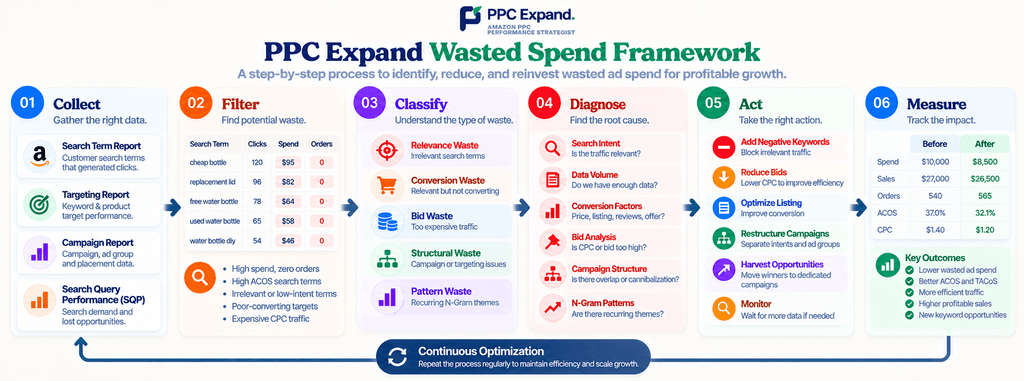
At PPC Expand, the objective is not simply to find “bad keywords.”
The analysis should move through six questions:
- Where is the money going?
- What traffic is generating that spend?
- Why is that traffic underperforming?
- Is the problem isolated or recurring?
- What is the most appropriate corrective action?
- Did the action improve the account?
This creates a closed optimization loop:
Collect → Analyze → Diagnose → Act → Measure → Repeat
29. How to Measure Whether Wasted Spend Actually Improved
Do not stop after adding negatives or lowering bids.
Measure the impact.
Useful before-and-after metrics include:
- Total spend
- Sales
- Orders
- ACOS
- TACoS
- Conversion rate
- CPC
- Wasted-spend segment
- New keyword sales
- Negative-target impact
For example:
| Metric | Before | After |
|---|---|---|
| Spend | $10,000 | $8,500 |
| Sales | $27,000 | $26,500 |
| Orders | 540 | 565 |
| ACOS | 37.0% | 32.1% |
| Average CPC | $1.40 | $1.20 |
Illustrative example only.
The important question is not whether spend decreased.
The important question is whether low-value spend decreased while valuable sales were protected or expanded.
30. Common Amazon PPC Wasted Spend Mistakes
Mistake 1: Negative every keyword with zero sales
Zero sales alone does not establish that a search term is irrelevant.
Mistake 2: Optimize only at campaign level
Campaign-level ACOS can hide significant differences between targets and search terms.
Mistake 3: Ignore conversion problems
Relevant traffic with poor conversion may require listing or offer optimization rather than negative targeting.
Mistake 4: Ignore N-Gram patterns
Large accounts can contain recurring themes that are difficult to detect through manual search-term review.
Mistake 5: Focus only on reducing spend
Reducing spend without protecting profitable traffic can reduce sales unnecessarily.
Mistake 6: Use one threshold for every campaign
Different products, objectives, price points, and conversion rates require different interpretations.
Mistake 7: Never measure after optimization
An optimization decision is incomplete until its impact is measured.
How Often Should You Analyze Amazon PPC Wasted Spend?
The appropriate frequency depends on account size, spend velocity, product lifecycle, and campaign activity.
For high-spend accounts, wasted-spend monitoring should be part of regular account management rather than an occasional cleanup exercise.
A practical framework could include:
- Frequent monitoring: High-spend campaigns and active launches
- Weekly analysis: Search-term and targeting changes
- Biweekly or monthly: Deeper N-Gram and structural analysis
- Quarterly: Broader campaign architecture and budget review
The more quickly an account spends, the more quickly inefficient traffic can consume meaningful budget.
Final Takeaway: Don’t Just Cut Spend—Improve Where the Spend Goes
Amazon PPC optimization is not about making the advertising account spend as little as possible.
It is about making every meaningful portion of the budget work harder.
Wasted spend can come from many sources:
- Irrelevant search terms
- Poor search intent
- Weak conversion
- High CPC
- Overaggressive bids
- Weak product targets
- Campaign overlap
- Poor match-type control
- Recurring negative themes
- Weak budget allocation
The strongest approach combines search-term analysis, negative targeting, N-Gram analysis, bid optimization, campaign architecture, product-targeting analysis, and conversion diagnosis.
Amazon’s own advertising tools provide automatic, manual, and negative targeting capabilities, while Search Term Reports and targeting reports provide data that can be used to refine where advertising dollars are allocated.
The ultimate goal is simple:
Cut low-value spend. Protect profitable traffic. Discover new opportunities. Reinvest the difference into scalable growth.
Frequently Asked Questions
What is wasted ad spend on Amazon?
Wasted Amazon PPC spend is advertising expenditure that does not generate sufficient business value relative to the campaign’s objective. It can include irrelevant clicks, poor-performing targets, excessive bids, weak-converting traffic, and other forms of inefficient budget allocation.
How do I find wasted Amazon PPC spend?
Start with search-term, targeting, and campaign performance data. Look for high-spend search terms, zero-order traffic, high ACOS, poor conversion, irrelevant searches, weak product targets, and recurring N-Gram patterns.
Should I negative every search term with no sales?
No. A zero-sale search term may simply have insufficient data or may be relevant traffic that is not converting because of price, listing quality, competition, or another factor. Evaluate the context before excluding it.
What is N-Gram analysis in Amazon PPC?
N-Gram analysis breaks search terms into individual words and word combinations to identify recurring performance patterns. It can help uncover both negative themes and profitable keyword opportunities.
Can N-Gram analysis reduce wasted spend?
Yes. It can help identify recurring words or phrases associated with poor-performing search terms. Those patterns can then be investigated and, where appropriate, addressed through negative targeting or other campaign changes.
Can wasted-spend analysis also find new keywords?
Yes. The same analysis can identify recurring words and phrases across high-performing search terms. These patterns may reveal keyword expansion opportunities.
What is the difference between a bad keyword and a bad search term?
A keyword is a targeting expression selected by the advertiser, while a customer search term is the query that triggered or was associated with the ad. A single keyword can produce many different search terms, some of which may perform very differently.
Should I reduce bids or add negative keywords?
It depends on the problem. If the traffic is fundamentally irrelevant, negative targeting may be appropriate. If the traffic is relevant but too expensive, bid optimization may be more appropriate. If relevant traffic receives clicks but does not convert, investigate the listing and offer before assuming the traffic itself is the problem.
What is the biggest mistake when reducing Amazon PPC waste?
The biggest mistake is treating every reduction in spend as a success. The objective is not simply to spend less; it is to reduce low-value spend while protecting and expanding valuable traffic.
Related Amazon PPC Resources
- Amazon Search Query Performance Report: Complete Guide
- How to Use Amazon Search Query Performance for PPC Optimization
- Amazon SQP Keyword Research: How to Find Hidden Keyword Opportunities
- Amazon PPC Search Term Mining: How to Find and Harvest High-Value Keywords
- Amazon PPC N-Gram Analysis: How to Find Wasted Spend and Hidden Keyword Opportunities